
Gwyddoniaeth Ymchwil Tystiolaeth: modelu'r gaeaf 2025 i 2026 - Part 11: appendix
Mae'r papur hwn yn darparu senarios wedi'u modelu ar gyfer y ffliw a niwmonia, COVID-19 a feirws syncytiol anadlol (RSV) ar gyfer tymor y gaeaf sydd i ddod.
Ar y dudalen hon
Retrospective analysis
To determine the effectiveness of the winter modelling produced and published in the 2024 to 2025 winter modelling report, we have compared the models with the recent admissions data received for the winter 2024 to 2025 period. Refer to the 2024 to 2025 winter modelling report for further detail on the definitions of each scenario shown (In Figures A1 to A4) below:
Figure A1: Comparison of flu and pneumonia daily admissions scenarios vs actuals in Wales between September 2024 and March 2025
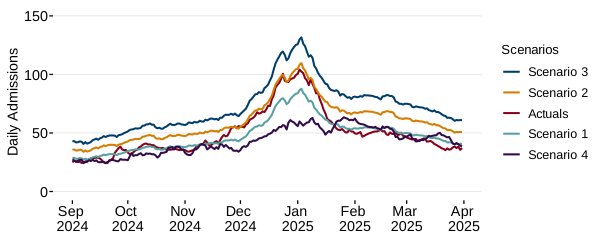
Description of Figure A1: A line chart showing projected daily hospital admissions due to flu and pneumonia in Wales, from September 2024 to March 2025, under four different scenarios, alongside actual admissions for comparison.
Source: Digital Health and Care Wales and SRE calculations
2024 to 2025 scenarios for flu and pneumonia predicted daily admissions peaking between 88 (scenario 1) and 132 (scenario 3) during the first week of January. Scenario 4 suggests a smaller peak of 63 in the third week of January (26 January 2025). Actual admissions data closely followed scenario 2, showing similar peak height and timing.
Figure A2: Comparison of RSV paediatric (ages 0 to 4) daily admissions scenarios vs actuals between September 2024 and March 2025
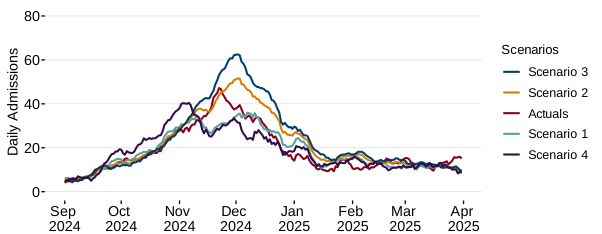
Description of Figure A2: A line chart showing modelled daily hospital admissions due to RSV in children aged 0 to 4 years in Wales from September 2024 to March 2025 under four scenarios, alongside actual admissions for comparison.
Source: Digital Health and Care Wales and SRE calculations
2024 to 2025 RSV Scenarios 1 to 3 suggested a peak of 36-63 daily admissions during the first week of December while Scenario 4 suggested an early peak of 40 admissions in the first week of November (06 November 2024). Actuals admissions showed a peak of 47 admissions on 22 November 2024.
Figure A3: Comparison of COVID-19 daily admissions scenarios vs actuals between July 2023 and March 2024
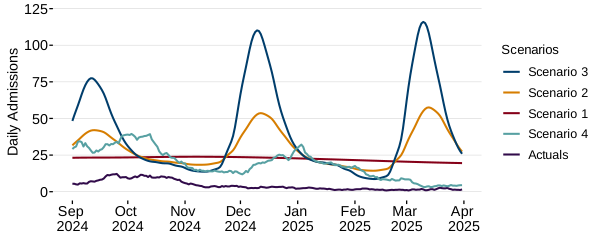
Description of Figure A3: A line chart showing modelled daily hospital admissions due to COVID-19 in from September 2024 to March 2025 under 4 scenarios, alongside actual admissions for comparison.
Source: Digital Health and Care Wales and SRE calculations
2024 to 2025 COVID-19 Scenario 1 indicated a flat time series with a maximum of 24 daily admissions while Scenarios 2 and 3 both suggested three peaks, occurring in the second weeks of September, December, and March (daily peaks of 42, 54, and 58 vs 77, 110, and 116 daily admissions respectively). Scenario 4 suggested two peaks: 39 admissions in the first week of October and 32 admissions in the first week of January. By contrast, actuals data showed no peak in winter and continued to show a decreasing trend through the winter.
Figure A4: Number of samples submitted for full-panel PCR testing in a non-sentinel setting across Wales, from April 2018 to March 2025.
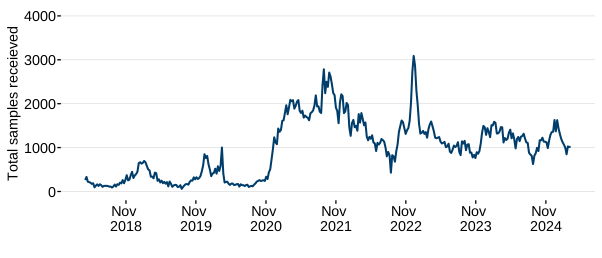
Description of Figure A4: A line chart showing the number of samples submitted for full-panel PCR testing in non-sentinel settings across Wales from April 2018 to March 2025, highlighting trends in testing volume over time.
Source: Public Health Wales
Testing protocols for infectious pathogens have evolved significantly since the onset of the pandemic. For example, as of January 2022, PCR samples processed for Coronavirus in NHS Wales laboratories can also be tested for influenza (flu) and respiratory syncytial virus (RSV). Testing may impact our admissions analysis, as ICD-10 codes depend on the accurate identification of the causative pathogen. Therefore, limited testing may result in an underestimation of admissions. Overall, testing has increased since the pandemic. During the winter of 2024/25, 32,390 samples were received for multiplex panel testing in non-sentinel context (hospitals and non-sentinel GPs). This is lower than the past two years, where 35,988 and 47,780 tests were used. However, to account for additional admissions that may not have been tested, broader categories such as pneumonia (J12-J18) and acute bronchitis and bronchiolitis (J20-J22, codes excluding RSV) are included in the combined scenarios.
Comparison of DHCW and ICNET datasets
Our winter modelling uses Patient Episode Database for Wales (PEDW) hospital admissions data from Digital Health and Care Wales (DHCW). However, due to a lag in clinical coding and in receiving PEDW data from DHCW, we use ICNET data from Public Health Wales (PHW) data for our actuals (observed data) for tracking throughout the winter. The data sources differ for a few reasons:
- the influenza, RSV and COVID-19 data from PHW includes lab-confirmed results only and includes inpatients only
- the PEDW data from DHCW is based on ICD10 codes and includes day case patients
To make the data sources more comparable, the ICD-10 codes for influenza and RSV were refined for specific pathogens. Influenza is now identified using ICD-10 codes J09 to J11 instead of J09 to J18, while RSV is identified with J12.1, J20.5, J21.0, and B97.4 instead of J20 to J22. These narrower code selections resulted in improved concordance between the datasets (see Figures A5 to A7).
Figure A5: Comparison of influenza admissions from DHCW and ICNET (PHW), Winter 2025 to 2026
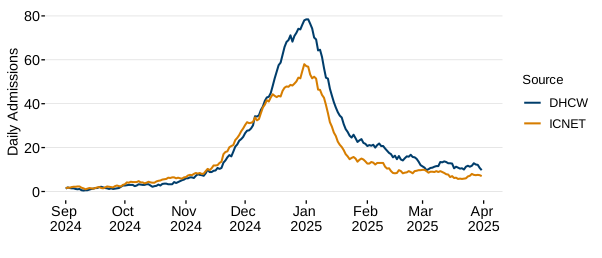
Description of Figure A5: A line chart showing daily hospital admissions due to influenza in Wales, from September 2024 to March 2025, comparing data from DHCW and ICNET (PHW). The lines represent admissions reported by each data source over the same period.Source: Digital Health and Care Wales and Public Health Wales.
Source: Digital Health and Care Wales and Public Health Wales
Figure A6: Comparison of RSV admissions (all ages) from DHCW and ICNET (PHW), Winter 2025 to 2026
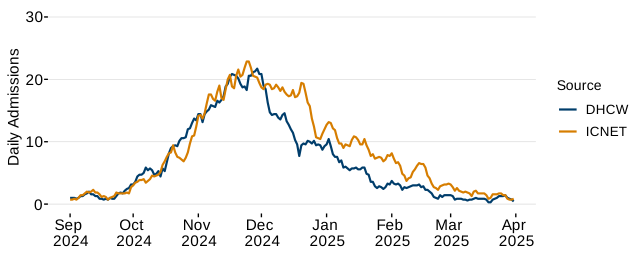
Description of Figure A6: A line chart showing daily hospital admissions due to RSV across all age groups in Wales, from September 2024 to March 2025. The lines represent admissions reported by DHCW and ICNET (PHW), allowing comparison between the two data sources.
Source: Digital Health and Care Wales and Public Health Wales
Figure A7: Comparison of COVID-19 admissions from DHCW and ICNET (PHW), Winter 2025 to 2026
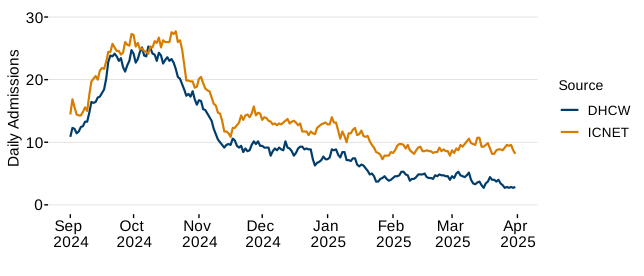
Description of Figure A7: A line chart comparing daily COVID-19 hospital admissions in Wales from September 2024 to March 2025, highlighting trends and differences between admissions reported by DHCW and ICNET (PHW).
Source: Digital Health and Care Wales and Public Health Wales
The five harms
Using the five harms framework, originally developed to assess risks in relation to Covid-19, Table 1 provides an assessment of potential harms arising from socioeconomic deprivation in relation to winter illnesses. Contributing factors are also given to show the mechanisms by which these harms may arise. Deprivation factors arising from low income, such as poor diet and fuel poverty, have been associated with increased vulnerability to respiratory illnesses (such as influenza and Covid-19) and exacerbation of various other health conditions.
Assessment of potential harms arising from socioeconomic deprivation in relation to winter illness
Direct Harms
Direct harms include:
- increased individual vulnerability to winter illness
- greater likelihood of severe illness requiring NHS care
- exacerbation of pre-existing conditions
- health and care staff burnout
- increased risk of poor care due to capacity issues in health settings
Contributing factors to direct harm include:
- hunger and malnutrition
- obesity and overweight
- cold, damp or poorly ventilated homes
- inadequate ventilation
- overcrowding in the home
- occupational exposure to contagious illness
- pre-existing comorbidities
- high demand across NHS services
- high health and care staff sickness absence rates over winter
Indirect harms
Indirect harms include:
- condition deterioration and pain management for patients awaiting planned procedures
- mental health concerns for patients facing delays
- staff burnout and mental ill-health from long-term increased workload beyond winter
- onward transmission of illness
- delayed medical care due to financial hardship
- adverse impacts on children’s education
Contributing factors to indirect harm include:
- cancellation of planned care due to winter pressures
- backlog of planned care due to cancelations to cope with winter pressures
- inability to take sickness absence from work due to financial hardship
- public perception of capacity issues and subsequent risks of poor service provision
- public fear of contracting winter illnesses
- absence from school due to sickness or needing to care for a sick family member
Harm arising from population-based health protection measures (such as, educational, psychological, or isolation)
Risks arising from population-based health protection measures include:
- communication challenges for some patients
- mental distress
Contributing factors to harm arising from population-based health protection measures include:
- mask mandates in medical settings in the event of high levels of respiratory illness
- increase in digital default appointments
- restrictions on hospital visiting in the event of high levels of illness
Economic harms
Risks from economic harm (macroeconomic factors) includes:
- lost working days
- lower labour market participation
- reduced tax revenue
- increased welfare spending
- households cutting back on spending
Risks from economic harm (microeconomic factors) includes:
- loss or reduction of income
- cutting back on essential expenditure
Contributing factors to economic harm include:
- sickness absence and long-term illness (for example, long COVID)
- absence from work due to caregiving
- benefits payments for long-term sickness
- increased budget pressure due to higher energy costs over winter
Harms arising from exacerbation or introduction of health inequalities
Risks from exacerbation or introduction of health inequalities include:
- difficulty in accessing medical care
- exacerbation of pre-existing conditions
- higher risk of contracting illness at work
Contributing factors to exacerbation or introduction of health inequalities include:
- public transport costs related to attending appointments or accessing care
- pistance to GP surgery, pharmacy, hospital
- poor weather conditions affecting public transport
- lower provision of medical care services in deprived areas despite increased need
- digital exclusion
- higher likelihood of existing poor health
- lower uptake of screening services and preventative programmes including vaccinations
- overrepresentation in occupations where it is not possible to work from home (such as, manufacturing, or hospitality)
- higher risk of occupational exposure to illness for ethnic minority groups, who are overrepresented in the health and care workforce
- reliance on or ineligibility for statutory sick pay leading to presenteeism
Clinical coding issues
The ICD-10 coding is used to systematically record and analyse mortality and morbidity data in hospitals in the UK. However, the completion of coding is often time-consuming, and experiences delays of several months. Therefore, the admissions reported for the financial year 2024 to 2025 in this paper are likely to be underestimated.
Forecasting model advantages and disadvantages
Moving Averages
Description: A statistical technique where values equal the observed value from the previous season or an average of previous seasons.
Advantages:
- simple to implement and understand
- requires no estimation of parameters
Disadvantages:
- assumes seasonal patterns remain unchanged over time
- treats all observations equally, ignoring recency effects
ETS (Exponential Smoothing)
Description: Applies exponentially decreasing weights to past observations, giving more influence to recent data in future predictions.
Advantages:
Requires less computational time than SARIMA • More flexible than moving averages
Disadvantages:
- may not capture complex autocorrelation structures
- sensitive to outliers
- performs better for short-term forecasts
SARIMA (Seasonal Autoregressive Integrated Moving Average)
Description: An extension of ARIMA, designed specifically for time series data with seasonal patterns.
Advantages:
- highly flexible in capturing complex seasonal patterns and trends
Disadvantages:
- sensitive to parameter selection
- computationally intensive
- performs better for short-term forecasts
Prophet
A machine-learning technique using an additive model with yearly, weekly, and daily seasonality, plus holiday effects.
Advantages:
- robust to outliers, missing data, and sudden changes
- effective when seasonality is regular and well-defined
- easy to implement and fast to run
Disadvantages:
- poor handling of complex seasonality (SARIMA performs better here)
- over-reliance on default parameters
Mechanistic compartment models
Mathematical models that divide populations into compartments (for example, susceptible, infected, or recovered) and simulate transitions between them.
Advantages:
- can model effects of interventions like vaccinations or NPIs
- performs better for long-term forecasts
Disadvantages:
- heavily reliant on accurate model parameters
- sensitive to initial conditions
Peaks analysis
Table A1: Peaks in 7-day rolling averages of influenza admissions between the winters of 2022 to 2023 and 2024 to 2025. [Note 1]
| Winter | Peak admission | Peak date |
|---|---|---|
| 1 Sep 2022 to 31 Mar 2023 | 109 | 24 December 2022 |
| 1 Sep 2023 to 31 Mar 2024 | 37 | 01 February 2024 |
| 1 Sep 2024 to 31 Mar 2024 | 78 | 01 January 2025 and 02 January 2025 |
Source: Digital Health and Care Wales
Note 1: Data for 2020 to 2021 and 2021 to 2022 winters are not shown due to low numbers
Table A2: Peaks in 7-day rolling averages of RSV paediatric admissions between the winters of 2022/23 and 2024/25. [Note 1]
| Winter | Peak admission | Peak date |
|---|---|---|
| 1 Sep 2022 to 31 Mar 2023 | 23 | 18 December 2022 |
| 1 Sep 2023 to 31 Mar 2024 | 21 | 11 November 2023 |
| 1 Sep 2024 to 31 Mar 2025 | 19 | 17 November 2024 and 18 November 2024 |
Source: Digital Health and Care Wales
Note 1: Data for 2020 to 2021 and 2021 to 2022 winters are not shown due to low numbers
Table A3: Peaks in 7-day rolling averages of COVID-19 admissions between the winters of 2020 to 2021 and 2024 to 2025. [Note 1]
| Winter | Peak admission | Peak date |
|---|---|---|
| 1 Sep 2020 to 31 Mar 2021 | 171 | 02 January 2021 |
| 1 Sep 2021 to 31 Mar 2022 | 96 | 06 January 2022 |
| 1 Sep 2022 to 31 Mar 2023 | 73 | 24 December 2022 |
| 1 Sep 2023 to 31 Mar 2024 | 40 | 03 October 2023 |
| 1 Sep 2024 to 31 Mar 2025 | 25 | 08 October 2024 |
Source: Digital Health and Care Wales
Note 1: COVID-19 admissions may show peaks during the summer that exceed those observed in the winter.
Table A4: Peaks in 7-day rolling averages of ED attendances due to respiratory problems between the winters of 2020 to 2021 and 2024 to 2025.
| Winter | Peak ED attendance | Peak date |
|---|---|---|
| 1 Sep 2020 to 31 Mar 2021 | 202 | 16 September 2020 |
| 1 Sep 2021 to 31 Mar 2022 | 272 | 21 October 2021 |
| 1 Sep 2022 to 31 Mar 2023 | 417 | 30 December 2022 |
| 1 Sep 2023 to 31 Mar 2024 | 286 | 1 January 2024 |
| 1 Sep 2024 to 31 Mar 2025 | 343 | 1 January 2025 |
Source: Digital Health and Care Wales
Table A5: Peaks in 7-day rolling averages of GP consultation rate due to acute respiratory infections in children (ages 0 to 14 years) between the winters of 2020 to 2021 and 2024 to 2025.
| Winter | Peak GP rate | Peak date |
|---|---|---|
| 1 Sep 2020 to 31 Mar 2021 | 24 | 16 September 2020 |
| 1 Sep 2021 to 31 Mar 2022 | 99 | 9 December 2021 |
| 1 Sep 2022 to 31 Mar 2023 | 369 | 9 December to 11 December 2022 |
| 1 Sep 2023 to 31 Mar 2024 | 110 | 28 December 2023 |
| 1 Sep 2024 to 31 Mar 2025 | 109 | 26 December 2024 |
Source: Public Health Wales
Table A6: Peaks in 7-day rolling averages of GP consultation rate due to acute respiratory infections in adults (ages 15 years and above) between the winters of 2020 to 2021 and 2024 to 2025.
| Winter | Peak GP rate | Peak date |
|---|---|---|
| 1 Sep 2020 to 31 Mar 2021 | 17 | 4 January 2021 |
| 1 Sep 2021 to 31 Mar 2022 | 46 | 4 January 2022 |
| 1 Sep 2022 to 31 Mar 2023 | 106 | 30 December 2022 to 2 January 2023 |
| 1 Sep 2023 to 31 Mar 2024 | 43 | 2 January 2024 |
| 1 Sep 2024 to 31 Mar 2025 | 37 | 26 December 2024 |
Totals analysis
Table A7: Total influenza admissions, between the winters of 2022 to 2023 and 2024 to 2025.
| Winter | Total Admissions |
|---|---|
| 1 Sep 2022 to 31 Mar 2023 | 3,892 |
| 1 Sep 2023 to 31 Mar 2024 | 2,437 |
| 1 Sep 2024 to 31 Mar 2025 | 4,349 |
Table A8: Total RSV paediatric admissions (ages 0 to 4 years), between the winters of 2022 to 2023 and 2024 to 2025.
| Winter | Total Admissions |
|---|---|
| 1 Sep 2022 to 31 Mar 2023 | 1,460 |
| 1 Sep 2023 to 31 Mar 2024 | 1,385 |
| 1 Sep 2024 to 31 Mar 2025 | 1,020 |
Table A9: Total COVID-19 admissions, between the winters of 2020 to 2021 and 2024 to 2025.
| Winter | Total Admissions |
|---|---|
| 1 Sep 2020 to 31 Mar 2021 | 14,970 |
| 1 Sep 2021 to 31 Mar 2022 | 14,127 |
| 1 Sep 2022 to 31 Mar 2023 | 8,315 |
| 1 Sep 2023 to 31 Mar 2024 | 4,248 |
| 1 Sep 2024 to 31 Mar 2025 | 2,228 |
Table A10: Total ED attendances due to respiratory problems, between the winters of 2020 to 2021 and 2024 to 2025.
| Winter | Total Admissions |
|---|---|
| 1 Sep 2020 to 31 Mar 2021 | 31,903 |
| 1 Sep 2021 to 31 Mar 2022 | 45,355 |
| 1 Sep 2022 to 31 Mar 2023 | 48,048 |
| 1 Sep 2023 to 31 Mar 2024 | 50,506 |
| 1 Sep 2024 to 31 Mar 2025 | 51,790 |