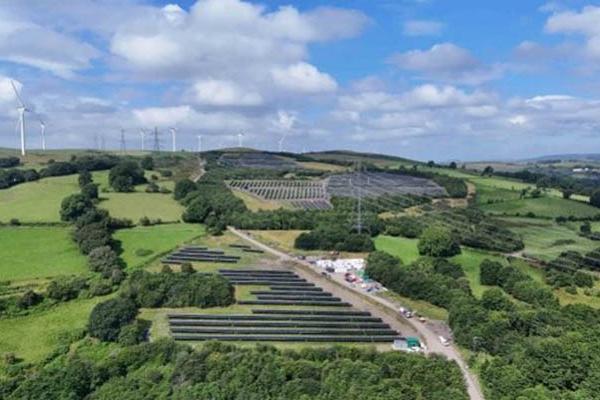
The overall project was to deliver a land based solar farm approximately 6MW in size to take advantage of the secured grid connection that feeds directly into the grid at 33kV.
Introduction
The overall project was to deliver a land based solar farm approximately 6MW in size to take advantage of the secured grid connection that feeds directly into the grid at 33kV. The solar farm project also provides a dedicated 1MW of power to Royal Glamorgan Hospital through an 11kV private wire, which was integrated with the (then concurrent) A4119 road improvement scheme. The project will save approximately 7,355 tCO₂e over the expected lifecycle of the project.
The Coed Ely Solar Farm is a flagship 6 MW renewable energy project delivered by Rhondda Cynon Taf County Borough Council (RCTCBC) in partnership with Cwm Taf Morgannwg University Health Board (CTM-UHB). Developed on a former colliery spoil tip, the scheme transforms redundant, post-industrial land into a productive clean energy asset, that also allows for sheep grazing and embraces biodiversity enhancements that support the transition to a net zero public sector.
The project combined technical and commercial innovation. It exports 5MW of renewable electricity to the national grid, while the pioneering 1 MW private wire connection supplies low-carbon power directly to the Royal Glamorgan Hospital. This ensures that locally generated energy delivers immediate benefits to critical healthcare services, improving resilience while reducing emissions and energy costs.
Underpinned by a long-term Power Purchase Agreement (or PPA), the model enables CTM-UHB to decarbonise without significant capital investment, while providing a stable revenue stream to the Council for reinvestment in public services.
Through strong cross-sector collaboration, Coed Ely demonstrates how local authorities can lead place-based decarbonisation by integrating clean energy generation, land regeneration, biodiversity enhancement and social value. It delivers on ambitions of a net zero infrastructure that benefits both communities and public services across Wales.
The Challenge
The Coed Ely Solar Farm was developed in response to the growing need for the public sector to accelerate decarbonisation, reduce exposure to volatile energy prices, and contribute towards Welsh Government's ambition for a Net Zero Public Sector.
RCTCBC's Decarbonisation Strategy includes an ambition to develop 15MW of renewable energy generation by 2030, and Coed Ely was identified as a strategic opportunity to make a significant contribution towards this target.
The scheme also helps deliver the ambitions set out within Rhondda Cynon Taf's Local Area Energy Plan (LAEP), which sets out a pathway to transition the local energy system towards net zero. The LAEP identifies the need to deploy renewable energy generation at scale, build a more resilient local energy system, reduce carbon emissions cost-effectively, and support the transition to a net zero public sector. Coed Ely directly contributes to these objectives by increasing local renewable generation capacity and supplying clean electricity to a major public sector estate.
A key challenge was transforming a former colliery spoil tip into a productive renewable energy asset whilst navigating complex planning, ecological, technical and commercial considerations. The project required securing and maximising the value of an available grid connection, managing site constraints, obtaining the necessary approvals and funding, and ensuring biodiversity enhancements could be delivered alongside the development.
Another significant challenge was ensuring the project generated benefits beyond renewable electricity production. Through collaboration with Cwm Taf Morgannwg University Health Board, the scheme sought to directly contribute to the decarbonisation of the Royal Glamorgan Hospital via a 1MW private wire connection. This required the development of innovative legal, technical and commercial arrangements, including a long-term Power Purchase Agreement that delivered value and long-term certainty for both organisations.
The challenge was therefore to deliver a financially viable, environmentally responsible and socially beneficial renewable energy project that could transform underutilised public land into a strategic asset, providing long-term carbon savings and energy resilience, whilst promoting wider benefits for public services and communities across the region.
The Approach
RCTCBC adopted a phased approach to deliver the Coed Ely Solar Farm. The project commenced by securing an economical grid connection whilst identifying a suitable site capable of supporting large-scale renewable energy generation. Early engagement with CTM-UHB enabled the development of an innovative commercial arrangement, including agreeing on a long-term PPA to provide low-carbon electricity directly to the Royal Glamorgan Hospital, via a private wire connection.
A multidisciplinary consultant team was procured to undertake site investigations, environmental assessments, design development and planning activities. The project team worked closely with internal stakeholders, regulatory bodies and external partners to address technical, ecological and planning requirements whilst securing the necessary approvals and funding to progress to the delivery stages.
Robust governance arrangements were established to oversee project development, manage risks and support decision-making throughout the project lifecycle. Following completion of the design and procurement stages, a specialist contractor was appointed to construct the solar farm and associated electrical infrastructure, including the private wire connection to the hospital.
The completed scheme comprises a 6MW solar farm that exports renewable electricity to the national grid whilst simultaneously supplying dedicated low-carbon power directly to the Royal Glamorgan Hospital. The site is now operated as a long-term renewable energy asset, delivering carbon reductions, biodiversity enhancements and financial benefits for both public sector organisations and the wider community.
Contributes Towards
The Coed Ely Solar Farm supports the delivery of RCTCBC's Corporate Plan 2024- 2030, Decarbonisation Executive Summary 2023-2025, and Local Area Energy Plan (LAEP)
The Council's Decarbonisation Strategy includes a target to develop 15MW of renewable energy generation by 2030. By bringing forward a 6MW solar farm on Council-owned land, Coed Ely makes a significant contribution towards this ambition, increasing local renewable energy generation to help reduce carbon emissions from public sector assets.
The project also supports the delivery of Rhondda Cynon Taf's ‘Local Area Energy Plan’ (or LAEP), which sets out the pathway to transition the local energy system, by increasing renewable energy generation, developing resilient energy infrastructure, reducing carbon emissions cost-effectively and supporting the decarbonisation of the public sector. The innovative private wire connection to the Royal Glamorgan Hospital demonstrates how local renewable energy can directly support the decarbonisation of critical public services.
In RCTCBC’s Corporate Plan 2024-2030 (Working with our Communities) the Council recognises that climate change is one of its greatest challenges and has established four Well-being Objectives, all of which are supported by the project:
- People and Communities: Supporting and empowering RCT residents and communities to live safe, healthy, and fulfilling lives
- Work & Business: Helping to strengthen and grow RCTs Economy
- Nature and The Environment: A green and clean RCT that improves and protects RCT’s environment and nature
- Culture, Heritage and Welsh Language: Recognising and celebrating RCT’s past, present and future
The project also contributes to the Well-being of Future Generations (Wales) Act 2015 by supporting a more prosperous, resilient and environmentally sustainable Wales through the repurposing of previously developed land, the generation of renewable energy, biodiversity enhancement and collaboration between local government and the NHS.
Impacts and Outcomes
The Coed Ely Solar Farm is a nationally significant project that demonstrates how public sector organisations can work collaboratively to accelerate decarbonisation. The scheme comprises a 6MW solar farm with 9,408 solar panels, exporting 5MWp of renewable electricity to the national grid whilst supplying 1MWp directly to the Royal Glamorgan Hospital via a 3.2km private wire connection.
The project combines technical and commercial innovation to deliver long-term environmental, economic and social benefits. Through a long-term PPA, CTM-UHB can access locally generated renewable electricity without capital investment, reducing both emissions and energy costs, whilst providing RCTCBC with a sustainable income stream that can be reinvested into public services and future decarbonisation initiatives.
Key outcomes include:
- Estimated lifetime carbon savings of 7,355 tCO₂e.
- Direct decarbonisation of a major NHS facility through an innovative private wire connection.
- Transformation of a former colliery spoil tip into a productive renewable energy asset.
- Increased renewable energy generation capacity, supporting RCTCBC's decarbonisation ambitions and renewable energy targets.
- Creation of a replicable model for collaboration between local authorities and health boards.
The project also delivers wider environmental benefits through the implementation of biodiversity enhancements and sustainable land management practices. The site will demonstrate how renewable energy infrastructure can coexist with ecological improvements and continued agricultural use, providing a best-practice example for future developments.
In addition, the project generates social value through community benefits secured during procurement and construction. These include opportunities for local employment, apprenticeships and educational engagement.
By bringing together land regeneration, renewable energy generation, biodiversity enhancement and public sector collaboration, Coed Ely Solar Farm provides a blueprint for how public assets can be used to support decarbonisation, strengthen local resilience and deliver long-term benefits for communities across Wales.
Lessons Learnt & Future Planning
The process of conceiving, designing and building the Coed Ely Solar Farm has provided some valuable lessons that will help shape the delivery of future renewable energy projects, both across the County Borough of Rhondda Cynon Taf, the wider region and the whole of Wales.
A key lesson was the importance of identifying and assessing suitable land based assets, early in the process, and then undertaking robust feasibility work to understand potential constraints and opportunities. Factors such as grid availability (and the economics of that), ground conditions, ecological requirements, planning considerations, nearby energy users (off takers), and funding opportunities should be assessed at the earliest stage to identify any potential project "showstoppers" and reduce delivery risk.
The project also demonstrated the importance of establishing clear governance arrangements, securing the necessary approvals, and identifying funding routes early in the development process. Early engagement with organisations such as the Welsh Government Energy Service (WGES) provided valuable technical, commercial and strategic support throughout development.
Another key lesson was the importance of procuring an experienced multidisciplinary team with the appropriate technical, legal, commercial and environmental expertise to support project design and delivery. Bringing together the right skills and stakeholders enabled the project to successfully navigate complex challenges and maximise project benefits.
Looking ahead, the Council will use the knowledge gained from Coed Ely to inform future renewable energy developments, particularly in relation to:
- Identifying and securing new economical grid connection opportunities.
- Developing further private wire projects that deliver direct benefits to public sector organisations and local energy users.
- Making best use of Council-owned land and assets to support decarbonisation.
- Reinvesting income generated from renewable energy assets into future decarbonisation and energy infrastructure projects.
- Strengthening collaboration across the public sector to maximise environmental, social and economic benefits.
Coed Ely has demonstrated how public assets can be used innovatively to support decarbonisation, create long-term value and build confidence towards the delivery of future large-scale renewable energy projects.