
Gwyddoniaeth Ymchwil Tystiolaeth: modelu'r gaeaf 2025 i 2026 - Part 4: background
Mae'r papur hwn yn darparu senarios wedi'u modelu ar gyfer y ffliw a niwmonia, COVID-19 a feirws syncytiol anadlol (RSV) ar gyfer tymor y gaeaf sydd i ddod.
Ar y dudalen hon
Winter peaks
To convey winter pressures for different elements of the health care system (admissions, ED attendances and GP consultations), a heat map was created:
Figure 1: Most likely modelled scenario pressures due to admissions, ED attendances and GP consultations between week 36 and 14 of Winter 2025 to 2026 [Note 1].
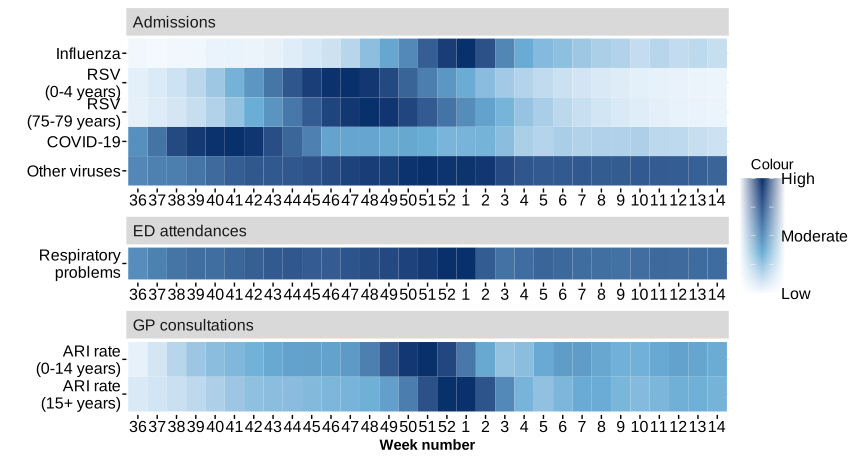
Description of figure 1: a heatmap comparing the likely winter pressure distribution across various infections and healthcare systems in Wales.
Sources: Digital Health and Care Wales (DHCW) and Public Health Wales
[Note 1]: The average value for each week was calculated from daily data. ‘High’, where the darkest blue is observed, refers to the estimated 2025 to 2026 winter peak. All other colours are relative to the estimated peak.
According to moderate modelling scenarios:
- admissions are projected to peak in week 47 for RSV (ages 0 to 4), week 48 for RSV (ages 75 to 79), week 1 for influenza, and week 41 for COVID-19 during the winter of 2025 to 2026
- ED attendances related to respiratory problems are anticipated to reach their highest levels between week 52 and week 1
- GP consultation rates for acute respiratory infections are expected to peak during weeks 51 and 52 for children aged 0 to 14 years and those aged 15 years and older, respectively
Last year’s modelling compared with actuals
The hospital admissions modelling scenarios for flu, RSV (ages 0 to 4), and COVID-19 provided in the 2024 to 2025 winter modelling report have been compared with the actuals provided by Digital Health and Care Wales, (DHCW) up to the end of 31 March 2025. The actuals fell within the scenarios for flu and RSV (age 0 to 4 admissions, but the COVID-19 actuals fell below those estimated by the modelling. This indicates the effectiveness of the modelling scenarios for planning purposes, particularly for flu and paediatric RSV hospital admissions in the 2024 to 2025 winter. Additional modelling techniques have been employed for the winter 2025 to 2026 modelling with the aim of further improving the effectiveness of the modelling.
Please see the appendix for further detail on last year’s 2024 to 2025 winter modelling compared to the actual number of hospital admissions which occurred.
What decisions does this winter modelling report inform?
The respiratory winter modelling of hospital admissions presented in this report are compared to the actuals on a weekly basis throughout the winter period (between September and March inclusive). They are presented at system resilience and planning meetings to stakeholders including NHS Performance and Improvement colleagues, Public Health Wales (PHW), and decision-makers in the Welsh Government and local health boards. This is to provide awareness and early warning of increases in respiratory illnesses particularly where the admissions may differ from what is expected allowing for earlier and effective planning. At these meetings, as well as the winter modelling, additional modelling is also provided which projects forward two weeks (short-term projections) to give an idea of estimated admissions over the coming fortnight. These models are also compared to actuals on a weekly basis throughout winter and are published in our respiratory surveillance reports. Alongside this winter modelling report, we have included two technical reports to provide users with more detail on the methodology, assumptions and limitations; one for the short-term projections, and another for the RSV epidemiological compartmental model used as part of this winter modelling work.
Local health board users also make use of the report and the underlying data of which they have access to which goes down to health board level. This year, health board decision makers will be able to access an interactive dashboard to consider and compare their historic data and winter scenarios with other health boards and with the overall Wales-level data.
Short-term projections
Short-Term Projections (STPs) are used to estimate healthcare demand during winter and assist in the efficient allocation of resources. The STPs model looks into spatial and temporal patterns in admissions across seven local health boards in Wales and estimates admissions up to two weeks in advance. It applies a flexible statistical method that identifies trends without modelling the underlying causes directly. The model is updated weekly as new data becomes available, and projections are adjusted accordingly. A limitation of the STPs model is its inability to accurately estimate peak timing. Therefore, it is essential to interpret the model's results with appropriate caution.