Pobl ifanc heb fod mewn addysg, cyflogaeth neu hyfforddiant (NEET): Gorffennaf 2025 i Fehefin 2026
Data ar nifer a chyfran y bobl 16 i 24 oed nad ydynt mewn addysg, cyflogaeth na hyfforddiant (NEET) yn ôl oedran, rhanbarth, anabledd ac ethnigrwydd ar gyfer Gorffennaf 2025 i Fehefin 2026. Saesneg yn unig.
Ar y dudalen hon
Background
This release summarises the Annual Population Survey (APS) statistics on young people not in education, employment or training (NEET) in Wales. The definitive source for NEET information is the annual statistical release, Participation of young people in education and the labour market, which uses a range of data sources to estimate participation and provides final estimates for 2023 and provisional estimates for 2024.
The estimates presented in this release provide more timely data than the Statistical First Release (SFR) series. They are used to provide an indication of trends in the proportion of young people who are NEET and to also provide additional breakdowns by characteristics.
It should be noted that each of these sources are estimates and are not directly comparable. Our guide to understanding the different sources of statistics on young people who are NEET in Wales provides further information.
APS estimates have become increasingly volatile in recent years and are less statistically robust than the SFR series with increasing divergence between the 2 data sources as indicated in the quality information section. However, the APS allows us to provide more detailed and timely statistics on young people (those aged 16 to 24) who are NEET which are outlined in this release.
APS estimates were previously classed as accredited official statistics. The APS has seen a fall in sample sizes over recent years. Given this and the fact that the survey has not been reweighted to latest population estimates, the OSR has agreed that this accreditation should be suspended and that the estimates should be re-designated as official statistics (ONS).
It is still appropriate to use these statistics, however please note the increased uncertainty around estimates derived from the APS. Users should consider trends presented in this release alongside trends published in the annual Participation of young people in education and the labour market release.
Due to small sample sizes, when looking at sub-groups it has been necessary to use estimates based on the average of 3 periods. Such estimates should be used to compare groups or regions only.
We recently consulted on the future frequency of this publication. Following broad support for reduced frequency, this release is now published six-monthly. Data on a rolling quarterly basis will continue to be made available alongside the six-monthly releases.
Main points
- The proportion of young people aged 16 to 24 who were NEET was 14.6% in the year ending June 2026, a decrease of 0.5 percentage points over the year.
- Of the economic regions, north Wales had the highest rate of young people aged 16 to 24 who were NEET in the three-year period ending June 2026 at 14.3% and mid and south west Wales had the lowest rate at 13.3%.
- In the three-year period ending June 2026, the proportion of disabled people who were NEET was 20.6% for those aged 16 to 18 and 39.1% for those aged 19 to 24.
- In the three-year period ending June 2026, 13.7% of young White people aged 16 to 24 were estimated to be NEET compared to 14.1% of young Black, Asian and Minority ethnic people aged 16 to 24.
Proportion of young people who are NEET
Figure 1: young people aged 16 to 24 not in education, employment or training (NEET), with 95% confidence intervals, year ending June 2016 to June 2026
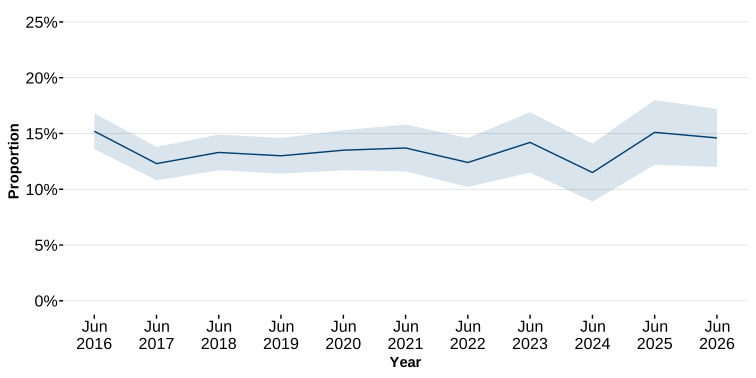
Description of figure 1: a line chart showing the proportion of 16 to 24 year olds who were NEET has remained relatively stable over the last decade despite the fluctuations in the data. Since 2020, the confidence intervals have widened following the impact of the coronavirus (COVID-19) pandemic on the survey.
Source: Welsh Government analysis of the APS.
Estimates of young people who are NEET by UK country and year on StatsWales
The proportion of young people aged 16 to 24 who were NEET was 14.6% in the year ending June 2026, down 0.5 percentage points over the year. Over the longer term, the rate increased by 0.9 percentage points over the last five years but decreased by 0.6 percentage points over the last decade.
Region
Figure 2: young people aged 16 to 24 not in education, employment or training (NEET) by economic regions, three-year period ending June 2026
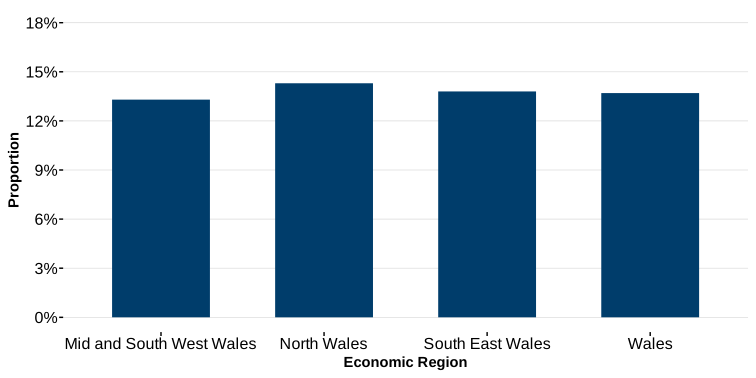
Description of figure 2: a bar chart showing that there are small differences in NEET rates between economic regions, with the highest rate being in North Wales and the lowest rate being in mid and south west Wales.
Source: Welsh Government analysis of the APS
In the three-year period ending June 2026, there were small differences in NEET rates between the economic regions. The proportion of young people aged 16 to 24 who were NEET varied from 13.3% in mid and south west Wales to 14.3% in north Wales.
Proportion of young people who are NEET by characteristic
Disability
The APS is the source of data for this release. It captures data using the medical definition of disability used in the Equality Act 2010 (“a physical or mental impairment which has a substantial and long-term impact on a person’s ability to carry out normal day to day activities”). For further information please see the disability definition.
Figure 3: young people not in education, employment or training (NEET) by disability and age group, three-year period ending June 2026 [Note 1]
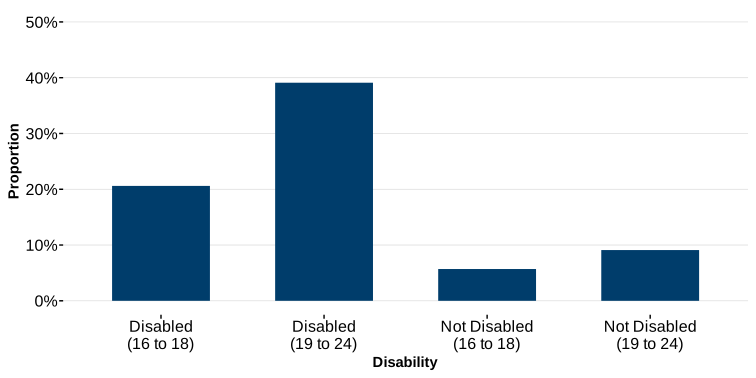
Description of figure 3: a bar chart showing disabled people are more likely to be NEET than people who are not disabled, with the largest proportion of those who are NEET being disabled people aged 19 to 24.
Source: Welsh Government analysis of the APS.
[Note 1]: The estimate for those aged 16 to 18 who are disabled is based on between 25 and 39 responses and is categorised as being of limited quality.
Disabled young people are far more likely to be NEET than young people who are not disabled. This difference is even more pronounced for 19 to 24 year olds than for 16 to 18 year olds. In the three-year period ending June 2026, the proportion of disabled people who were classed as NEET was 20.6% at age 16 to 18 and 39.1% at age 19 to 24.
Ethnicity
The survey asks respondents what they consider to be their ethnic origin. The White category includes White – Welsh/English/Scottish/Northern Ireland/British and any other White background including Gypsy and Irish Travellers.
Figure 4: young people aged 16 to 24 not in education, employment or training (NEET) by ethnicity, three-year period ending June 2026 [Note 1]
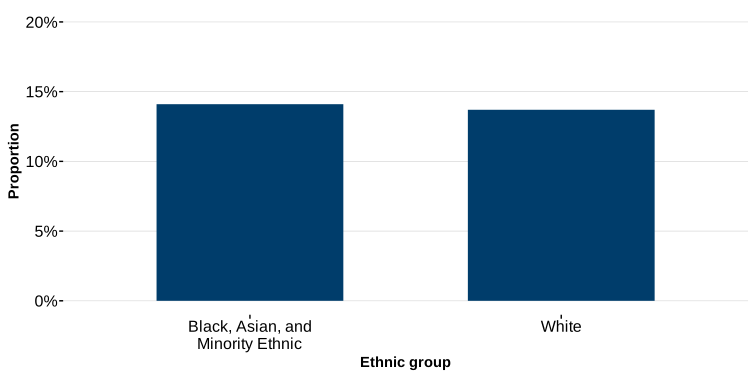
Description of figure 4: a bar chart showing that a similar proportion of young Black, Asian and Minority Ethnic people and young White people were NEET in the latest period
Source: Welsh Government analysis of the APS
Three-year average estimates of young people who are NEET by ethnicity and year on StatsWales
[Note 1]: The estimate for Black, Asian and Minority Ethnic people is based on between 10 and 24 responses and is categorised as being of low quality.
In the three-year period ending June 2026, young White people (aged 16 to 24) were less likely to be NEET than young Black, Asian and Minority Ethnic people. 13.7% of young White people were estimated to be NEET compared to 14.1% of young Black, Asian and Minority ethnic people.
Definitions
Education and training
For APS based estimates: respondents to the APS who are either:
- currently carrying out an apprenticeship
- currently on a government employment or training scheme
- currently working or studying towards any qualifications
- have undertaken any job-related education or training in the previous 4 weeks
- currently enrolled on any full-time or part-time education course excluding leisure classes and are still attending or waiting for term to (re)start
Employment
From the APS respondents are in employment if they are either:
- employed
- self-employed
- on government employment or training programmes
- an unpaid family worker
Disability
The Welsh Government accepts the social definition of disability, in which it is recognised that barriers in society act to disable people who have impairments or health conditions or who use British Sign Language.
The APS is the source of data for this release. It captures data using the medical definition of disability used in the Equality Act 2010 (“a physical or mental impairment which has a substantial and long-term impact on a person’s ability to carry out normal day to day activities”). Figures within this release are not comparable to those within releases prior to 2015, which reported those reporting DDA current disability or work-limiting disability.
Region
The APS has been used to estimate the proportion of young people who are NEET by economic region. However, due to smaller sample sizes for single year estimates for those aged 16 to 18, the estimates have been averaged over three rolling years for 16 to 24 year olds. The regions in use are as follows:
North Wales
- Isle of Anglesey
- Gwynedd
- Conwy
- Denbighshire
- Flintshire
- Wrexham
Mid and south west Wales
- Powys
- Ceredigion
- Pembrokeshire
- Carmarthenshire
- Swansea
- Neath Port Talbot
South east Wales
- Bridgend
- Vale of Glamorgan
- Rhondda Cynon Taf
- Merthyr Tydfil
- Caerphilly
- Blaenau Gwent
- Torfaen
- Monmouthshire
- Newport
- Cardiff
Quality information
This release summarises the statistics available from the APS on young people aged 16 to 24 not in education, employment or training in Wales. It is updated on a six-monthly basis with the latest estimates from the APS.
The definitive source for NEET information is the SFR, Participation of young people in education and the labour market, which uses a range of data sources to estimate participation.
However, the APS allows us to provide more detailed and timely statistics on young people who are NEET which are outlined in this release.
APS estimates have become increasingly volatile in recent years and are less statistically robust than the SFR estimates with increasing divergence between the 2 data sources.
A gender and age group split of the proportion of young people who are NEET is available in the latest SFR release which contains data up to and including the provisional estimates for the 2024 calendar year.
Further information on both this APS series and the SFR on young people who are NEET, as well as NEET estimates from the Careers Wales pupil destinations survey, is provided in our guide to understanding the different sources of statistics on young people who are NEET in Wales.
The SFR data will be used to monitor the National Indicator related to ‘Percentage of people in education, employment or training’ laid under the Well-being of Future Generations Act 2015.
Relevance
The statistics are used within the Welsh Government to monitor trends in the level and proportion of young people who are NEET.
The Youth Engagement and Progression Framework was originally published in 2013 and was refreshed in September 2022. The Framework is a systematic mechanism to identify and respond to young people at risk of becoming NEET, who are NEET and/or who are at risk of being homeless. It focuses on young people aged 11 to 18 and is built of 6 core components:
- Early identification
- Brokerage
- Monitoring progression
- Provision
- Employability and employment opportunities
- Accountability
Accuracy
The APS is a household survey carried out by the Office for National Statistics (ONS). The survey seeks information on respondents' personal circumstances, including their labour market status and their education and training activity. The APS combines the boosted samples of the Labour Force Survey (LFS) and provides rolling 4 quarter data.
As the data come from a survey, the results are sample-based estimates and are therefore subject to differing degrees of sampling variability; the true value for any measure lies in a differing range about the estimated value. Approximate 95% confidence intervals have been calculated for the APS estimates of the proportion of young people aged 16 to 24 who are NEET and are included in figure 1 and the StatsWales tables published alongside this release.
Confidence intervals have been revised for the full time series in this release to provide more robust estimates of uncertainty. Estimates and confidence intervals have been calculated using the srvyr package in R, incorporating the survey weights included in the APS. The variance estimation does not incorporate the full survey design information, such as stratification or clustering, and therefore the confidence intervals should be regarded as indicative measures of uncertainty rather than fully design-adjusted confidence intervals.
Additionally, the adjustment method for apportioning missing values creates an artificial aggregated sample size used in the calculation of confidence intervals. As the level of detail in data increases so does the sampling variability, which means that estimates become less reliable. Due to this, estimates for sub-groups of the population and lower geographical regions are based on three-year averages.
Further information about the quality of the APS (ONS)
The ONS recalibrated the weights of APS datasets in 2022 for periods covering the year ending March 2020 to the year ending December 2022. Further information on this reweighting and its impact is available in an article published by the ONS on the Impact of reweighting the LFS (ONS).
The APS has not yet been reweighted in line with the LFS reweighting in February 2024 to include the latest population estimates. This reweighting of LFS estimates was carried out following a decrease in data quality, APS estimates will continue to be published based on the previous LFS weighting methodology until further notice.
Accessibility and clarity
This statistical release is pre-announced and then published on the Statistics and Research section of the Welsh Government website. The release is published as an accessible HTML alongside StatsWales tables. Both the release and StatsWales tables follow accessibility guidelines.
Comparability and coherence
Figure 5: young people aged 16 to 24 who are NEET, 2010 to 2024
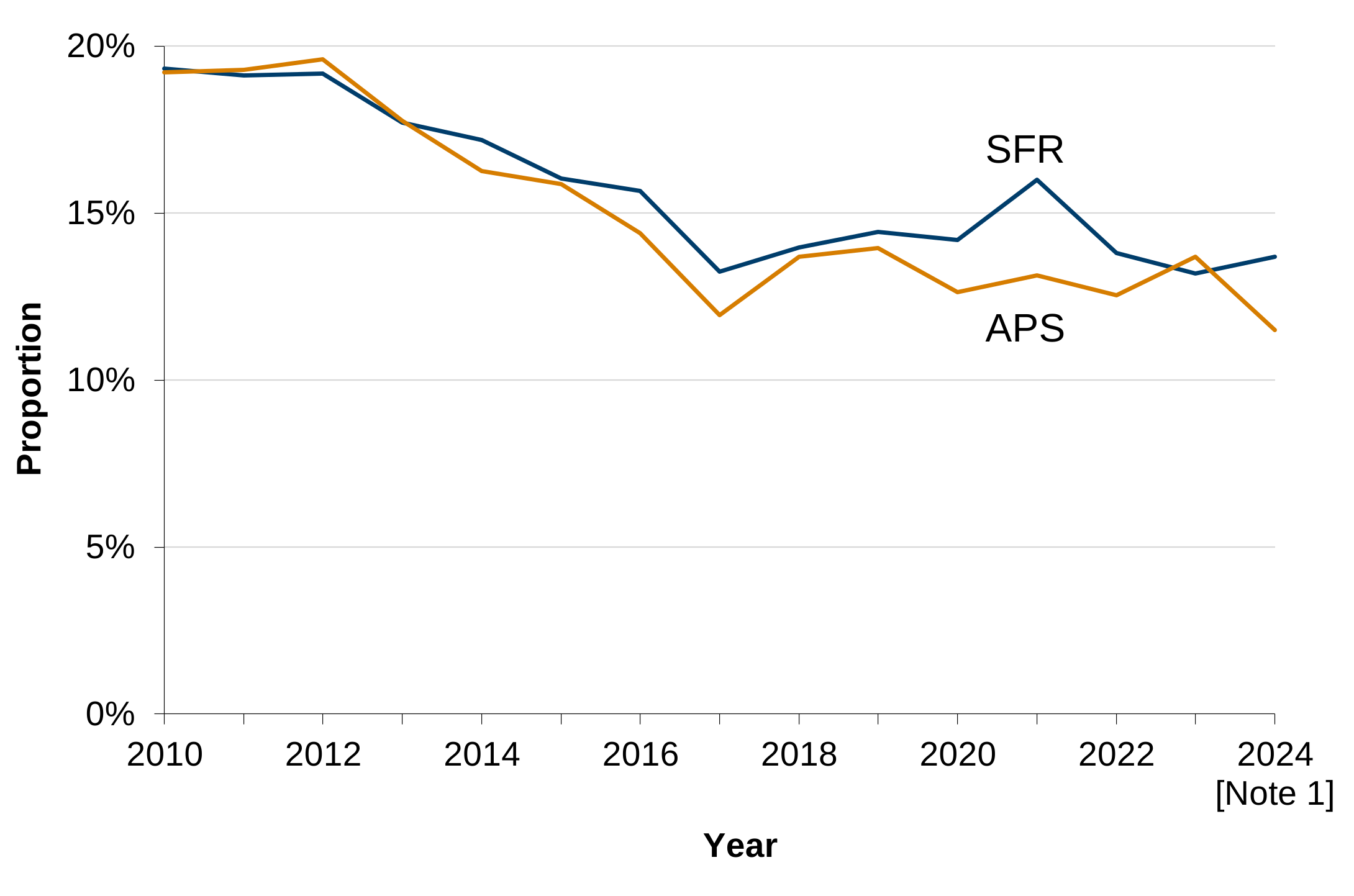
Description of Figure 5: a line chart comparing the NEET rates from the SFR to the APS series for 16 to 24 year olds. Both measures show a similar trend in the NEET rates for 16 to 24 year olds since 2010, however the deviations between the SFR and APS series have generally been larger since 2020.
Source: Welsh Government analysis of the SFR and APS series on NEETs
[Note 1]: definitive annual series figures for 2024 are provisional.
APS based estimates of young people who are NEET by year on StatsWales
SFR based estimates of young people who are NEET by year on StatsWales
The method used to define young people who are NEET using the APS is harmonised with an agreed UK methodology of deriving NEET estimates. More information can be found within the paper published by the ONS: UK Estimate of Young People Not in Education, Employment or Training.
Labour Force Survey/Annual Population Survey
The Department for Education (DfE) also publish an annual brief on young people who are NEET which includes NEET rates estimates based on the quarterly LFS. Additionally, from May 2013 the ONS has produced UK estimates of young people who are NEET, also based on the quarterly LFS.
The quarterly estimates are not directly comparable with the Welsh APS-only estimates published in this release. A direct comparison for Wales with England and the UK LFS measure is not provided as the sample size for 16 to 18 year olds and 19 to 24 year olds in Wales is not sufficiently large. However, using a similar methodology to that used by the ONS, but using the APS rather than the LFS, we can provide estimates of young people who are NEET across the UK. These estimates are provided on StatsWales and published alongside this release.
These estimates will differ from other official estimates produced by the DfE, ONS and other relevant departments due to different underlying methodologies being used and should therefore be interpreted with caution.
Statement of compliance with the Code of Practice for Statistics
Our statistical practice is regulated by the OSR. OSR sets the standards of trustworthiness, quality and value in the Code of Practice for Statistics that all producers of official statistics should adhere to.
All of our statistics are produced and published in accordance with a number of statements and protocols to enhance trustworthiness, quality and value. These are set out in the Welsh Government’s Statement of Compliance.
These official statistics demonstrate the standards expected around trustworthiness, quality and public value in the following ways.
Trustworthiness
We publish guidance for users on the different NEET sources for Wales. This includes detailed guidance on the differences between the sources and definitions, and brief overview of the methodology used for each source.
The data for this release have been calculated from the APS and tabulated by Welsh Government statisticians with a focus on ensuring that the statistics, data and explanatory material is presented impartially and objectively whilst providing advice on data quality and interpretation.
All personal data underlying these statistics are processed in accordance with the requirements of the Data Protection Act 2018.
These statistics are pre-announced on the Statistics and Research area of the Welsh Government website. Access to the data during processing is restricted to those involved in the production of the statistics, quality assurance and for operational purposes. Pre-release access is restricted to eligible recipients in line with the Code of Practice (UK Statistics Authority).
Quality
The data in this release all originate from the APS run by the ONS. APS estimates have become increasingly volatile in recent years and are less statistically robust than the SFR series with increasing divergence between the two data sources. However, the APS allows us to provide more detailed and timely statistics on young people (those aged 16 to 24) who are NEET which are outlined in this release.
APS estimates were previously classed as accredited official statistics. The APS has seen a fall in sample sizes over recent years, given this and the fact that the survey has not been reweighted to latest population estimates, the OSR has agreed that this accreditation should be suspended and that the estimates should be re-designated as official statistics (ONS).
It is still appropriate to use these statistics, however please note the increased uncertainty around estimates derived from the APS. Users should consider trends presented in this release alongside trends published in the SFR: Participation of young people in education and the labour market, the definitive source for NEET information for Wales.
All stages in the collection, validation and production of these statistics are led by professional statisticians. All statistics are quality-assured prior to publication.
Value
Our official statistics on young people who are NEET show the trends in the proportion of young people aged 16 to 24 that are NEET. These statistics have been published at the earliest opportunity to assist users in understanding the latest trends in NEET rates. The statistics will be updated on a six-monthly basis throughout the year.
These statistics are used in a variety of ways. Some examples of these are:
- advice to ministers
- to inform education and employability policy decision making process
- to assist and monitor progress for programmes aimed at providing and improving educational and employment opportunities to young people
This release is accompanied by StatsWales tables, a free to use service that allows visitors to view, manipulate, create and download data.
The commentary and notes in the release have been developed to try to make the information as accessible as possible to the widest range of users.
You are welcome to contact us directly with any comments about how we meet these standards. Alternatively, you can contact OSR by emailing regulation@statistics.gov.uk or via the OSR website.
Well-being of Future Generations Act (WFG)
The Well-being of Future Generations Act 2015 is about improving the social, economic, environmental and cultural well-being of Wales. The Act puts in place seven well-being goals for Wales. These are for a more equal, prosperous, resilient, healthier and globally responsible Wales, with cohesive communities and a vibrant culture and thriving Welsh language. Under section (10)(1) of the Act, the Welsh Ministers must (a) publish indicators (“national indicators”) that must be applied for the purpose of measuring progress towards the achievement of the Well-being goals, and (b) lay a copy of the national indicators before the Senedd Cymru. Under section 10(8) of the Well-being of Future Generations Act, where the Welsh Ministers revise the national indicators, they must as soon as reasonably practicable (a) publish the indicators as revised and (b) lay a copy of them before the Senedd. These national indicators were laid before the Senedd in 2021. The indicators laid on 14 December 2021 replace the set laid on 16 March 2016.
The SFR data published in the Participation of young people in education and the labour market release will be used to monitor the National Indicator and milestone related to:
- (22) Percentage of people in education, employment or training, measured for different age groups.
Information on the indicators, along with narratives for each of the well-being goals and associated technical information is available in the Wellbeing of Wales report.
As a national indicator under the Act they must be referred to in the analyses of local well-being produced by public services boards when they are analysing the state of economic, social, environmental and cultural well-being in their areas.
The Act states national milestones must be set that “…the Welsh Ministers consider would assist in measuring whether progress is being made towards the achievement of the well-being goals.” In doing so Welsh Ministers must specify how we know that a national milestone has been achieved and the time by which it is to be achieved.
National milestones are not performance targets for any individual organisation, but are collective measures of success for Wales.
Indicator 22: percentage of people in education, employment or training, measured for different age groups corresponds to a national milestone:
- At least 90% of 16 to 24 year olds will be in education, employment, or training by 2050
Further information on the Well-being of Future Generations (Wales) Act 2015.
The statistics included in this release could also provide supporting narrative to the national indicators and be used by public services boards in relation to their local well-being assessments and local well-being plans.
We want your feedback
We welcome any feedback on any aspect of these statistics which can be provided by email to labourmarket.stats@gov.wales
Contact details
Labour Market and Skills Statistics
Email: labourmarket.stats@gov.wales
Media: 0300 025 8099
SB 34/2026