
Plant sy'n derbyn gofal a chymorth: Ebrill 2023 i Fawrth 2025 (ystadegau swyddogol o dan ddatblygiad)
Information on assessments of need for care and support plans for children for April 2023 to March 2025. Saesneg yn unig.
Ar y dudalen hon
Introduction
These statistics provide analysis of characteristics and attributes of children aged under 18 receiving care and support. This covers children who had a care and support plan at any point during the reporting years 1 April 2023 to 31 March 2024 and 1 April 2024 to 31 March 2025. More detailed information is also provided for children receiving care and support on the 31 March census date.
Data for this release were collected from the children receiving care and support census, using an updated methodology compared with previous years. Prior to April 2023, the census reported a snapshot of children who had an active care and support plan which had been in place for 3 months or more on the census date of 31 March. In the updated methodology, any child who had a care and support plan at any point during the year is included. The requirement for care and support plans to have been active for at least 3 months has been removed. As such, overall figures are not directly comparable with previous years.
To have a care and support plan, children will have had an assessment of their care and support needs. The assessment will have concluded that the child has eligible needs that can only be met through a care and support plan. Part 4 Code of Practice (Meeting Needs) under the Social Services and Well-being (Wales) Act 2014 provides information on the duties of a local authority in meeting needs for care and support.
Main points
During 2024 to 2025
Around 27,633 children receiving care and support had a care and support plan at any point during the year. This is equivalent to around 4.5 children in every 100, which is a similar number and rate to 2023 to 2024.
8,357 children receiving care and support during the year had their care and support plan closed and did not have a care and support plan on 31 March 2025. Of these, where known, nearly three-quarters (73%) had their plan closed because the service had been completed.
On 31 March 2025
Around 19,276 children were receiving care and support and had an active care and support plan. This is equivalent to around 3.1 children in every 100, which is a small increase on 31 March 2024.
Where known, 4% of children receiving care and support had caring responsibilities.
Where known, 4% of children receiving care and support aged 10 or over had a plan in place or being developed with the Youth Offending Team.
Risk of, or actual, abuse or neglect was the most common reason why children had started receiving care and support and was the main reason for half (50%) of children receiving care and support.
Children receiving care and support at any point during the year
There were 27,633 children who had a care and support plan at any point during the year, from 1 April 2024 to 31 March 2025. This is equivalent to around 4.5 children in every 100. These figures are similar to 2023 to 2024, where there were 27,209 (4.4 in every 100) children receiving care and support at any point during the year.
The number with a care and support plan is an indicator of the level of care and support needs that local authorities are required to meet and gives a high-level overview of social services demand.
Care and support plans closed
8,357 children who had care and support during the year 1 April 2024 to 31 March 2025 had their care and support plan closed during the year and did not have an active plan on 31 March 2025.
Figure 1: reasons for closure of care and support plans during the year, 2024 to 2025 [Note 1]
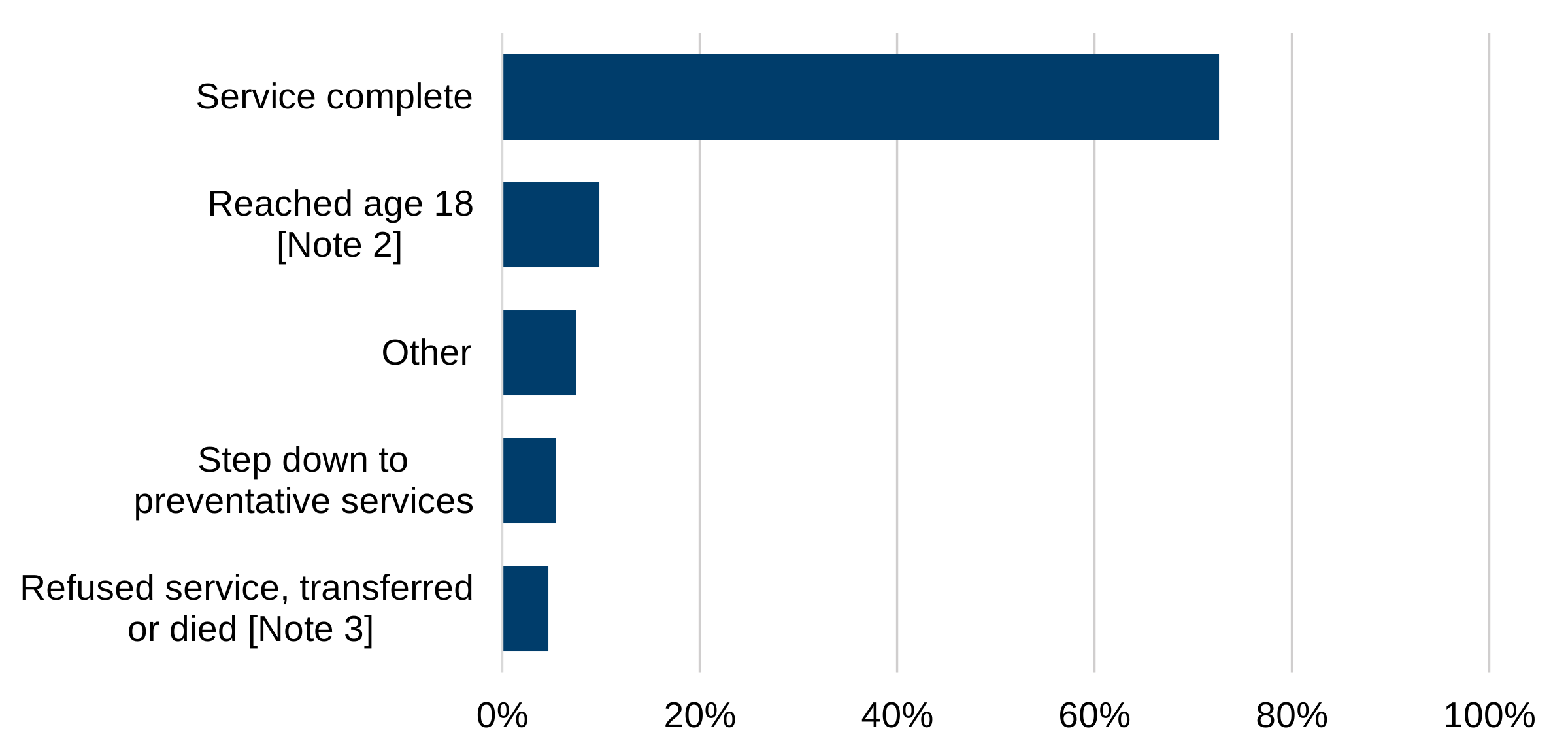
Description of figure 1: a bar chart showing that the most common reason for closure of a child’s care and support plan was the service had been completed.
Source: Children receiving care and support census, Welsh Government
[Note 1]: Children who had a care and support plan closed but no reason given have not been included.
[Note 2]: Where a care and support plan was active on 31 March and the child was aged 18 or over, the plan was closed on the child’s 18th birthday and the reason for plan closure was given as the child had reached age 18.
[Note 3]: Where a care and support plan was active on 31 March, the child was aged 18 or over, and they appeared in the adults receiving care and support census data, the plan was closed on the child’s 18th birthday and the reason for plan closure was given as the child had transferred to the care of adult services.
Where the reason for care and support plan closure was known, nearly three-quarters (73%) of children whose care and support plan was closed in 2024 to 2025 had their plan closed due to the service being completed. 10% of children had their care and support plan closed due to them reaching age 18, 7% for “Other” non-specified reasons and 5% due to stepping down to preventative services (and no longer requiring ongoing care and support). Reason for closure was missing for 15% of children whose care and support plan was closed during 2024 to 2025.
Compared with reasons for closure for care and support plans in 2023 to 2024, there was a large increase in care and support plans being closed due to the child reaching the age of 18, or due to the reason “Other”. Differences are likely impacted by adjustments made in both years. In 2024 to 2025, care and support plans closed during the year with no reason given were subsequently allocated to “Other” reasons. These records are not included in Figure 1 above.
Children with an active care and support plan on 31 March
There were 19,276 children with an active care and support plan on 31 March 2025. This is equivalent to around 3.1 children per 100. This is a small increase compared with 18,649 children, or 3.0 children in every 100 with an active care and support plan on 31 March 2024.
Of these children, 7,102 (37%) were looked after by a local authority and 2,502 (13%) children were on the child protection register (CPR). There were 152 children who were both looked after and on the child protection register – these have been included in the children looked after total. The remaining 9,672 (50%) children were neither looked after by a local authority nor on the CPR. These are similar to proportions on 31 March 2024.
Data as at the census date provide a picture at a point in time and further insight of characteristics of children receiving care and support which is not captured in the during the year data.
Characteristics of children receiving care and support
Age
Figure 2: children receiving care and support by age, 31 March 2025
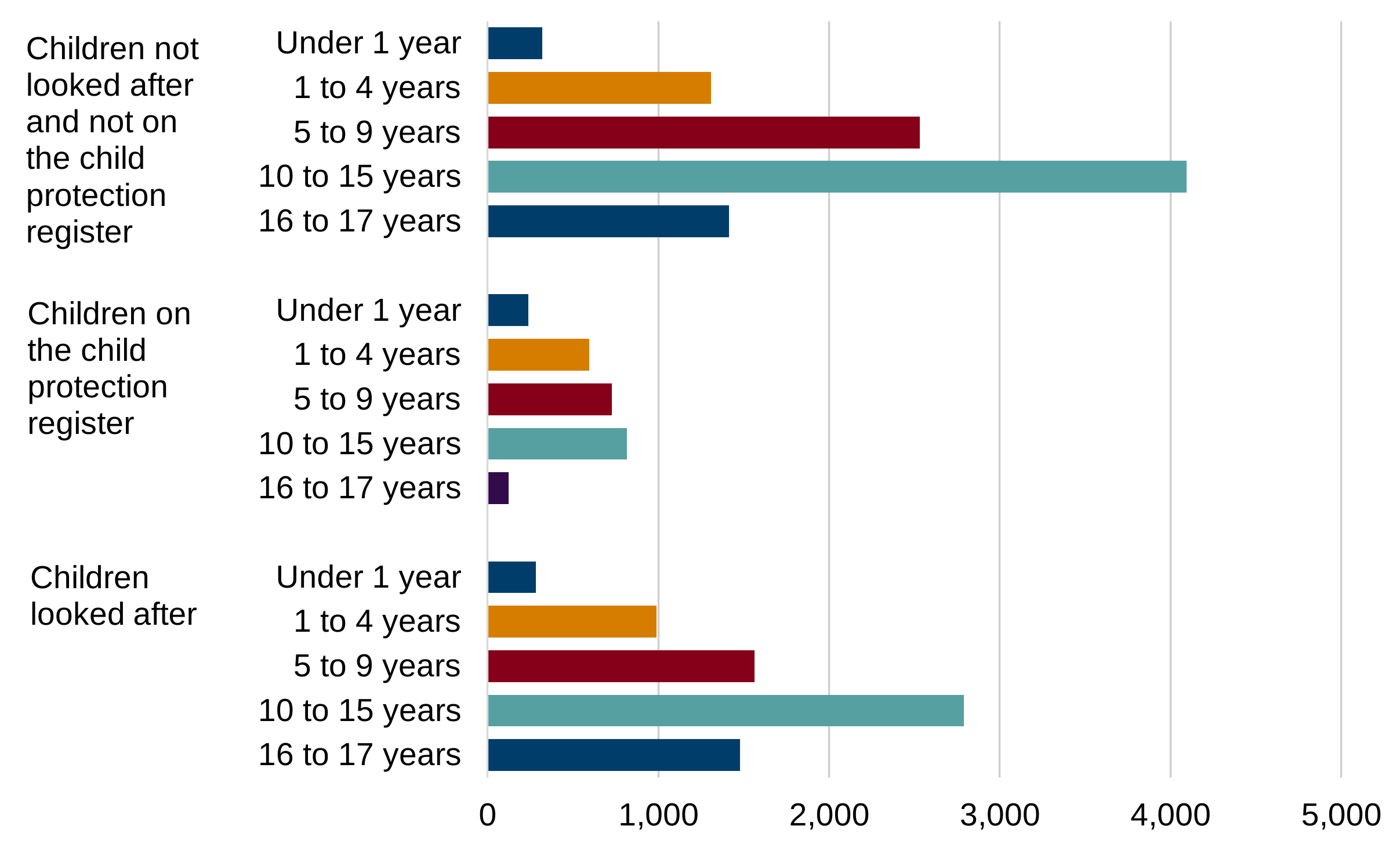
Description of figure 2: a bar chart showing that the age group 10 to 15 years was the most prevalent for children receiving care and support, whether they were looked after, on the child protection register, or neither.
Source: Children receiving care and support census, Welsh Government
Nearly a fifth (19%) of children with an active care and support plan on 31 March 2025 were under the age of 5, a quarter (25%) were aged 5 to 9 years old, two-fifths (40%) were aged 10 to 15 years old, and the remaining 16% were aged 16 or over.
Children receiving care and support who were on the child protection register were generally younger than other children receiving care and support, while children looked after were generally older. These age-related patterns were consistent with children receiving care and support on 31 March 2024.
Disability
Almost a quarter (24%) of children receiving care and support on 31 March 2025 were disabled, where the child had a physical or mental impairment which had a substantial and long-term adverse effect on their ability to carry out normal day-to-day activities. This compares with 21% of children receiving care and support on 31 March 2024 reported as having a disability.
This is much higher than the proportion of the general population aged under 18 years old who stated they had a long-term health problem or disability that limits their day-to-day activities (7%) according to the Census 2021 ('Disability by age, sex and deprivation, England and Wales: Census 2021' (Office for National Statistics (ONS)).
Figure 3: top 5 impairment categories reported for children receiving care and support, 31 March 2025
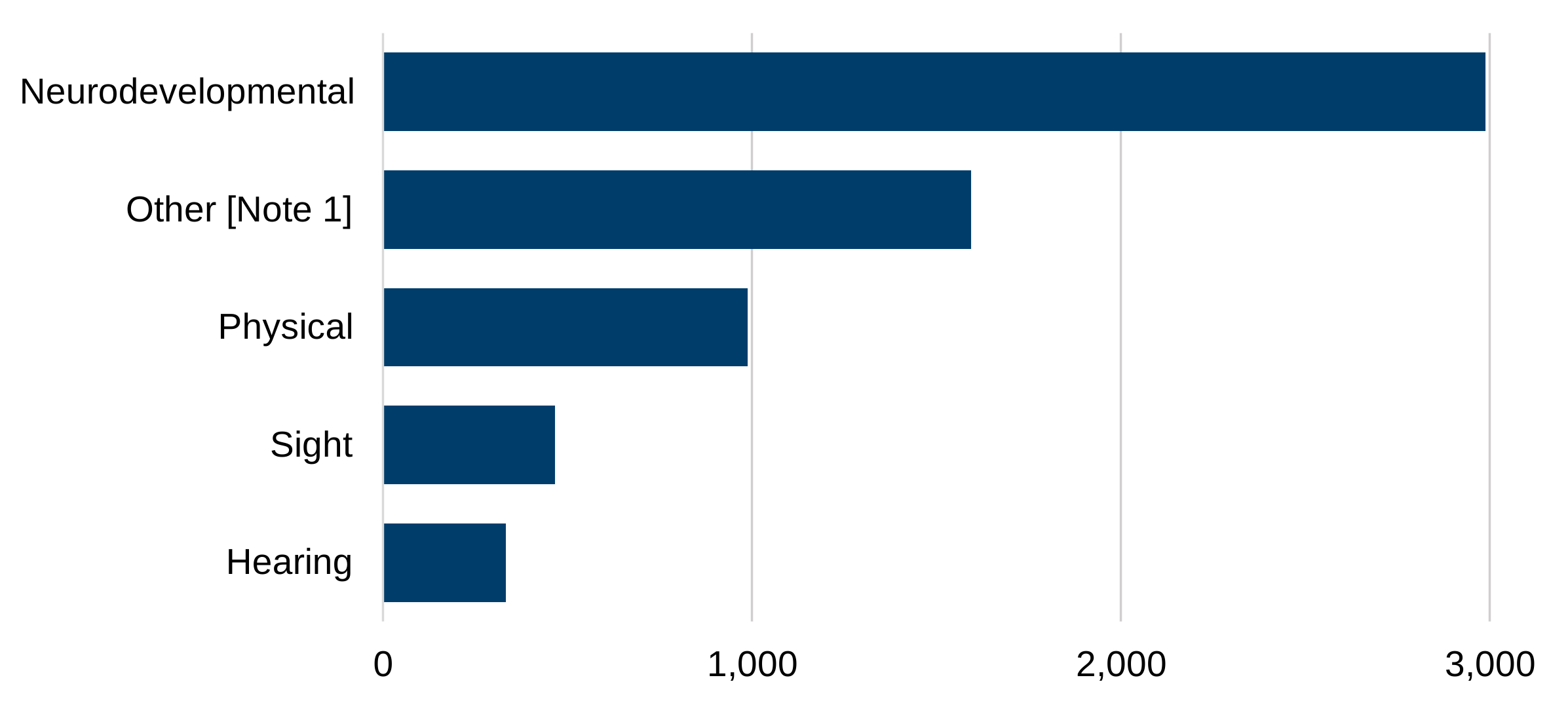
Description of figure 3: a bar chart showing the most prevalent impairment category for children receiving care and support on 31 March 2025 was neurodevelopmental.
Source: Children receiving care and support census, Welsh Government
[Note 1]: The “Other” category contains records where an impairment category of “Other” was given, as well as where the child had reported having a disability, but no impairment category was given.
The most prevalent impairment category reported among children receiving care and support with a disability on 31 March 2025 was neurodevelopmental. This was recorded for 65% of children with a disability, while 35% of children reported an impairment from the “Other” category, and 22% reported a physical impairment. This breakdown was similar among children receiving care and support on 31 March 2024.
35% of children who were neither looked after nor on the child protection register were reported as having a disability, compared with 15% of children looked after and 8% of children on the child protection register (and not looked after).
Gender
55% of children receiving care and support were male and 45% were female on 31 March 2025. Children with gender recorded as non-binary or unknown accounted for fewer than 1% of children receiving care and support on 31 March 2025. These figures were consistent with children receiving care and support on 31 March 2024.
Ethnicity
On 31 March 2025, where ethnicity of children receiving care and support was recorded:
- 89% of children receiving care and support were from a White ethnic group
- 4% were from a mixed ethnic group
- 3% were from an Asian or Asian British ethnic group
- 2% were from a Black, African, Caribbean or Black British ethnic group
- 2% were from other ethnic groups
The proportions for all ethnic groups were similar compared with the previous year, and to the general population aged under 18 years old according to the Census 2021 ('Ethnic group by age and sex in England and Wales' (ONS)).
Preferred language
Most (88%) children receiving care and support on 31 March 2025 who were of an applicable age (aged 3 or over), and where information was recorded, reported English as their preferred language. Welsh was the preferred language of 2% of children. 4% of children had other specified preferred languages whilst 6% had either another preferred language which was not listed, or the information was unknown or not able to be communicated. These percentages were similar for children receiving care and support on 31 March 2024.
Asylum status
2% of children receiving care and support were either unaccompanied asylum seekers or members of asylum-seeking families on 31 March 2025. Of these children, nearly all (94%) were looked after by a local authority. Asylum status was missing for 20% of children receiving care and support.
Caring responsibilities
Where information is known, 4% of children receiving care and support on 31 March 2025 had caring responsibilities, nearly all of whom were receiving known ongoing support as carers. A higher proportion of children that were neither looked after by a local authority nor on the child protection register had caring responsibilities (7%), when compared with children on the child protection register (3%) and children looked after (1%). Caring responsibilities data were missing for 20% of children receiving care and support.
Youth offending
Where information is available for applicable children receiving care and support (aged 10 and over), 4% had a plan in place or being developed with the Youth Offending Team on 31 March 2025. This is the same proportion as on 31 March 2024. About three-quarters of children with a youth offending plan in place or in development were male, at 76% on 31 March 2025 compared with 73% on 31 March 2024. Youth offending data was not known for 8% of children aged 10 and over receiving care and support.
Need for care and support
As part of a child’s assessment, their needs for care and support are identified. If a child’s assessment leads to the provision of a care and support plan, the main reason why a child started to receive care and support from local authority social services is recorded.
Figure 4: children receiving care and support by need for care and support, 31 March 2025
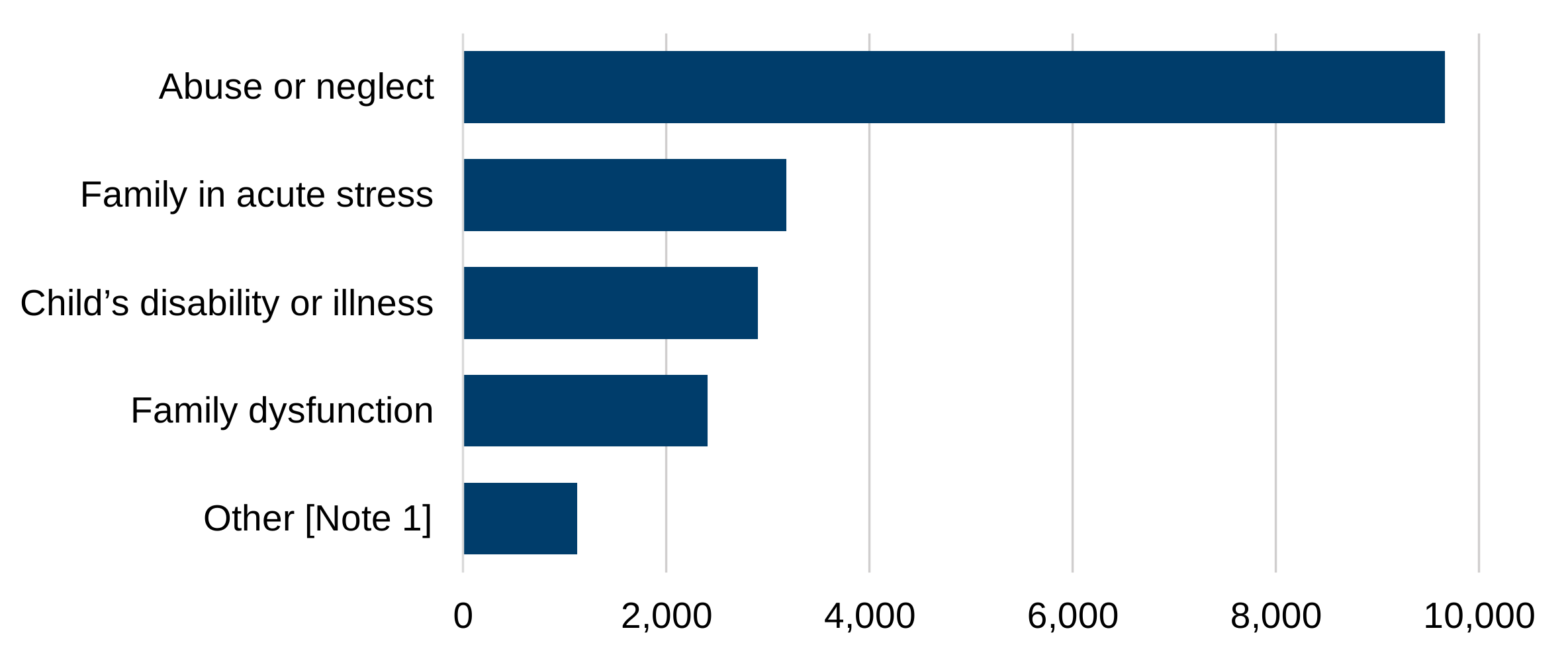
Description of figure 4: a bar chart showing the most prevalent need for care and support among children receiving care and support on 31 March 2025 was due to the risk of, or actual, abuse or neglect.
Source: Children receiving care and support census, Welsh Government
[Note 1]: Other categories of need are socially unacceptable behaviour, absent parenting, parental disability or illness, and adoption disruption.
Half (50%) of children receiving care and support on 31 March 2025 had the need for care and support primarily because of the risk of, or actual, abuse or neglect. The proportion was higher for children who were looked after or on the child protection register (65% and 59% respectively) compared with children who were not looked after and not on the child protection register (37%). This also varied by age with higher proportions of children starting to receive care and support because of abuse or neglect in the younger age groups (under 1 and 1 to 4 years). This decreased with age. This pattern was similar among children with an active care and support plan on 31 March 2024.
The second most prevalent need for care and support was family in acute stress which was recorded for 17% of children receiving care and support. This increased from 15% of children receiving care and support on 31 March 2024. A higher proportion of children starting to receive care and support because of family in acute stress were in the under 1 year old age group compared to other age groups.
Child’s disability or illness was the primary category of need for care and support reported for 15% of children receiving care and support, which remained consistent from the previous year. This varied by age with the lowest proportion of children starting to receive care and support because of disability or illness in the under 1 year old age group. This increased with age. Overall, 91% of children starting to receive care and support due to disability or illness were neither looked after nor on the child protection register.
The other prominent primary reason for care and support was family dysfunction, which was reported for 12% on 31 March 2025 compared with 15% on 31 March 2024. Socially unacceptable behaviour, parental disability or illness, absent parenting and adoption disruption were much less common reasons and combined were reported for 6% of children receiving care and support on 31 March 2025.
Quality and methodology information
Data are sourced from the children receiving care and support census based on updated methodology from April 2023. The collection captures children with a care and support plan as detailed in the Social Services and Well-being (Wales) Act 2014 (UK legislation). The data collection guidance document provides explanations of the data items and response categories captured within the data collection.
The number of children receiving care and support with a care and support plan on 31 March does not equal CH/015a the number of children with a care and support plan from the Social Services Performance and Improvement Framework dataset (StatsWales) for all local authorities.
Figures in this release do not always match those reported in other social services data collections. Differences may reflect reporting requirements and timings, the populations covered and validation processes applied. Further information on these differences is available in the quality report.
Disability
The Welsh Government accepts the social definition of disability, in which it is recognised that people with impairments are disabled by barriers that commonly exist in society. However, data have been collected based on the Equality Act 2010 which uses the medical model of disability.
Population estimates
The rate of children receiving care and support per 100 population aged under 18 for 2023 to 2024 has been calculated based on the 2023 mid-year estimates published by the ONS. The equivalent rate for the year 2024 to 2025 was calculated based on the 2024 mid-year estimates.
Statistical designation
These statistics are published as official statistics in development. The underpinning data collection process is newly updated and continues to be embedded across all local authorities.
Percentages in this release have been calculated based on children where known information was provided and are rounded to the nearest per cent.
Extensive quality assurance was undertaken with local authorities. Not all local authorities provided complete returns, and some adjustments have been made to data.
Detailed information on quality can be found in the children receiving care and support quality report.
Statement of compliance with the Code of Practice for Statistics
Our statistical practice is regulated by the Office for Statistics Regulation (OSR). OSR sets the standards of trustworthiness, quality and value in the Code of Practice for Statistics that all producers of official statistics should adhere to.
All of our statistics are produced and published in accordance with a number of statements and protocols to enhance trustworthiness, quality and value. These are set out in the Welsh Government’s Statement of Compliance.
These official statistics in development (OSR) demonstrate the standards expected around trustworthiness, quality and public value in the following ways.
Trustworthiness
Local authorities submit data annually on spreadsheets via Objective Connect, a web-based tool to securely share and receive files. Data collection is based on detailed guidance.
The published figures are compiled by professional analysts using the latest available data and applying methods using their professional judgement and analytical skillset.
These statistics are pre-announced on the Statistics and Research area of the Welsh Government website. Access to the data during processing is restricted to people involved in the production of the statistics, quality assurance and for operational purposes. Pre-release access is restricted to eligible recipients in line with the Code of Practice (UK Statistics Authority).
Quality
Our statistics are produced to high professional standards and are produced free from any political interference.
Validation checks are performed by Welsh Government statisticians and queries referred to local authorities where necessary.
The statistical release is approved by senior statisticians before publication. Data are published in line with statement on confidentiality and data access each year.
Value
The purpose of the statistical release is to inform users about the number and characteristics of children receiving care and support. Specifically, children with a care and support plan, from local authorities in Wales. This information is published alongside other data on social services activity and children looked after by local authorities to give a more complete picture of children receiving care and support and the activity of Children’s Social Services.
There is a 19-month lag between the latest reference period of the statistics and publication. The statistics are published with Wales level analysis and commentary, in addition to open data format tables with local authority level analysis which are published on StatsWales.
You are welcome to contact us directly with any comments about how we meet these standards. Alternatively, you can contact OSR by emailing regulation@statistics.gov.uk or via the OSR website.
Well-being of Future Generations Act (WFG)
The Well-being of Future Generations Act 2015 is about improving the social, economic, environmental and cultural wellbeing of Wales. The Act puts in place 7 wellbeing goals for Wales. These are for a more equal, prosperous, resilient, healthier and globally responsible Wales, with cohesive communities and a vibrant culture and thriving Welsh language. Under section (10)(1) of the Act, the Welsh Ministers must (a) publish indicators (“national indicators”) that must be applied for the purpose of measuring progress towards the achievement of the wellbeing goals, and (b) lay a copy of the national indicators before Senedd Cymru. Under section 10(8) of the Well-being of Future Generations Act, where the Welsh Ministers revise the national indicators, they must as soon as reasonably practicable (a) publish the indicators as revised and (b) lay a copy of them before the Senedd. These national indicators were laid before the Senedd in 2021. The indicators laid on 14 December 2021 replace the set laid on 16 March 2016.
Information on the indicators, along with narratives for each of the wellbeing goals and associated technical information is available in the Wellbeing of Wales report.
Further information on the Well-being of Future Generations (Wales) Act 2015.
The statistics included in this release could also provide supporting narrative to the national indicators and be used by public services boards in relation to their local wellbeing assessments and local wellbeing plans.