
Darpariaeth llety digartrefedd a chysgu allan: Mehefin 2026
Data am bersonau a wedi'u rhoi mewn llety dros dro a phobl sydd yn cysgu allan ar gyfer Mehefin 2026. Saesneg yn unig.
Ar y dudalen hon
Introduction
This publication covers rough sleepers and the provision of temporary and long-term accommodation for homeless people who present to local authorities for housing support.
Detailed breakdowns, including by local authority, can be found on StatsWales (Homelessness accommodation provision and rough sleeping).
Data on households applying to local authorities for housing assistance under the Housing (Wales) Act 2014 (UK legislation) are also regularly published by Welsh Government. However, users need to be aware of the differences between this monthly data collection and the collection on statutory homelessness.
The Vale of Glamorgan has not provided data since October 2025. Their October 2025 data has been used as an estimate for all subsequent months. See the quality and methodology section for further information on the potential impact of using these estimates.
Main points
- 10,339 individuals were housed in temporary accommodation on 30 June 2026.
- Of those in temporary accommodation, the majority (2,502) were housed in local authority stock.
- 158 individuals were estimated to be sleeping rough on 30 June 2026.
During June 2026, there were:
- 1,359 occurrences of homeless people placed into temporary accommodation
- 733 homeless individuals moved into suitable long-term accommodation
Use of temporary accommodation [footnote 1] [footnote 2] [footnote 3]
Individuals placed into temporary accommodation during the month
Figure 1: occurrences of people placed into temporary accommodation during the month, April 2023 to June 2026
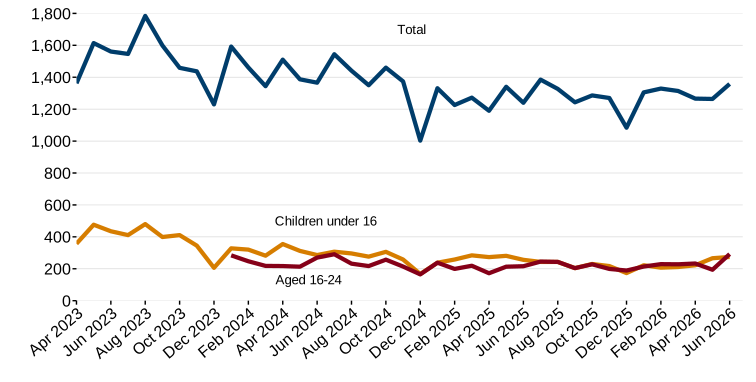
Description of figure 1: a line chart showing that the total occurrences of people, children under 16 and those aged 16 to 24 placed into temporary accommodation fluctuates. The data is described in more detail in the following text.
Source: Welsh local authority homelessness services
Since April 2023, the number of homeless individuals placed into temporary accommodation has displayed notable fluctuations. Each year, the lowest number of placements is recorded in December. Excluding December, placements have fluctuated between roughly 1,200 to 1,400 since January 2025.
The highest recorded figure was 1,785 in August 2023, whilst the lowest was 1,002 in December 2024. A similar pattern is evident in the placement of children under 16 with placements peaking at 480 in August 2023 before falling to 168 in December 2024. For individuals aged 16 to 24, the monthly figures have fluctuated between 170 and 300 since January 2024.
In June 2026 there were 1,359 occurrences of homeless people placed into temporary accommodation. This is higher than the figure recorded in June 2025, but lower than that recorded in June 2024 and June 2023.
273 placements were dependent children aged under 16. This is also higher than the figure recorded in June 2025 but lower than that recorded in June 2024 and June 2023. 291 placements were individuals aged 16 to 24 years old, which is the joint-highest figure recorded since January 2024.
There have been 15,432 placements into temporary accommodation in the last 12 months. Repeat placements are common; 16% of placements into temporary accommodation in June 2026 were of individuals who had previously been placed into temporary accommodation within the last 12 months.
Figure 2: occurrences of people placed into temporary accommodation by reason for homelessness, June 2026
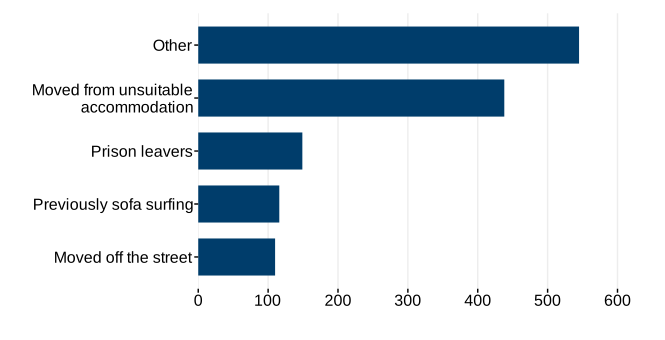
Description of figure 2: a bar chart indicating that the most common reasons for the placement of individuals into temporary accommodation are being moved from unsuitable accommodation and ‘other’.
Source: Welsh local authority homelessness services
Most placements into temporary accommodation during June 2026 were recorded under ‘other’ (546 occurrences). The next most common reason was individuals being moved from unsuitable accommodation (438 occurrences). Together, these 2 categories account for over 72% of placements into temporary accommodation.
‘Other’ circumstances include being homeless at home, being homeless following an emergency, such as a fire or flood, and returning from abroad. It also includes any other reason for homelessness not covered in the categories above.
Accommodation may be unsuitable for a range of reasons. These include overcrowding, a risk of violence or environmental issues. Accommodation may also be unsuitable if adaptations are needed following discharge from hospital. In some cases, the resident may need supported accommodation that isn’t available in their current housing.
Homeless individuals in temporary accommodation at 30 June 2026
Figure 3: homeless individuals living in temporary accommodation at the end of the month, April 2023 to June 2026
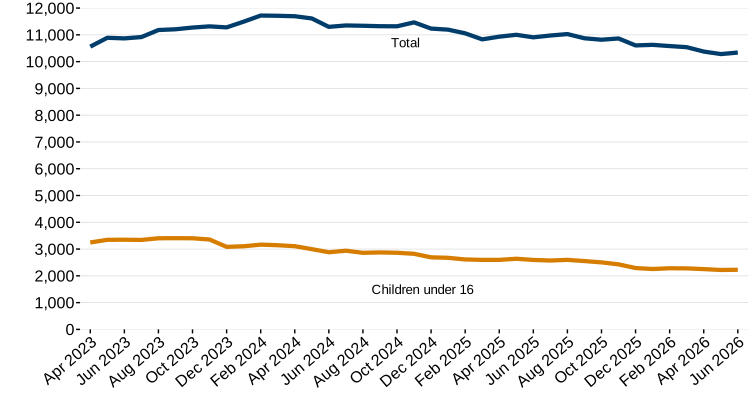
Description of figure 3: a line chart showing that the number of children under 16 in temporary accommodation at the end of the month has decreased since the start of the series. The total number of homeless individuals in temporary accommodation at the end of the month has fluctuated. The data is described in more detail in the following text.
Source: Welsh local authority homelessness services
From April 2023 there was a gradual increase in the number of individuals in temporary accommodation, reaching a peak of 11,721 in February 2024. Since then, numbers have decreased and are now slightly below the level in April 2023.
On 30 June 2026, 10,339 individuals were in temporary accommodation, which is lower than the number recorded during June in each of the last 3 years. 2,227 of these were dependent children aged under 16, which is also lower than the number recorded during June in each of the last 3 years. The number of dependent children in temporary accommodation has remained stable in recent months, with numbers remaining below 2,500 since November 2025.
Figure 4: homeless individuals temporarily accommodated, by type of accommodation, 30 June 2026
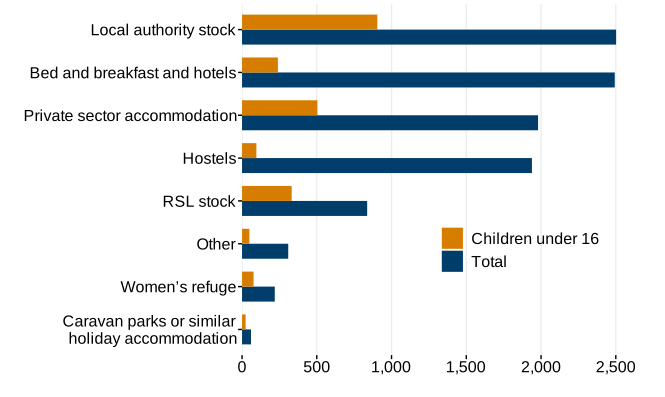
Description of figure 4: a bar chart showing that the type of accommodation housing the largest number of homeless individuals is local authority stock (2,502). This is followed by bed and breakfast and hotels (2,493), private sector accommodation (1,980) and hostels (1,939).
Source: Welsh local authority homelessness services
At the end of June 2026, most individuals were housed in local authority stock, with 24% of those in temporary accommodation in this type of accommodation. This is the first time that local authority stock has accommodated a greater number of individuals than bed and breakfast and hotel accommodation. Of those in local authority stock, 36% (905) were dependent children under 16 years old.
Bed and breakfast and hotels, private sector accommodation and hostels were the other most common types of accommodation used. However, this varied between local authorities (for local authority breakdowns see StatsWales). Children under 16 are most commonly housed in local authority stock, private sector accommodation and RSL stock.
Homeless individuals moved into suitable long-term accommodation
Figure 5: homeless individuals moved into suitable long-term accommodation during the month, April 2023 to June 2026 [footnote 4]
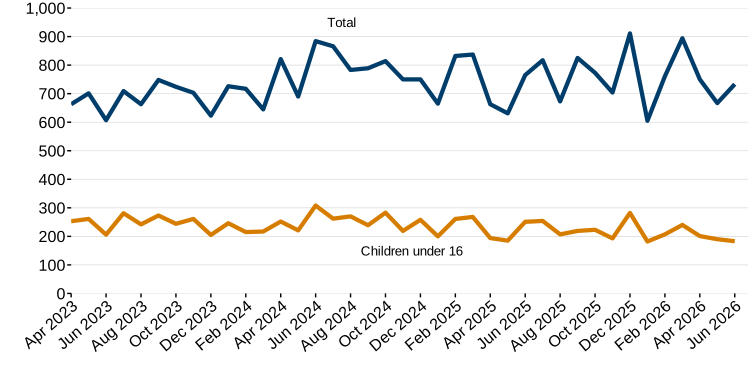
Description of figure 5: a line chart showing that the total number of homeless individuals and children under 16 moved into suitable long-term accommodation fluctuates each month. The data is described in more detail in the following text.
Source: Welsh local authority homelessness services
Since April 2023, the number of homeless individuals moved into suitable long-term accommodation has fluctuated between roughly 600 to just over 900 individuals each month. These figures have varied month to month without a consistent trend. For children under 16 years old, the numbers have similarly fluctuated, ranging from roughly 180 to just over 300 individuals.
In June 2026, 733 homeless individuals were moved into suitable long-term accommodation. This is lower than the figure recorded in June 2025 and June 2024 but higher than that recorded in June 2023. Of these, 183 were dependent children aged under 16, which is the joint-lowest figure recorded since April 2023.
Rough sleepers
Figure 6: number of rough sleepers in Wales, April 2023 to June 2026 [footnote 5] [footnote 6]
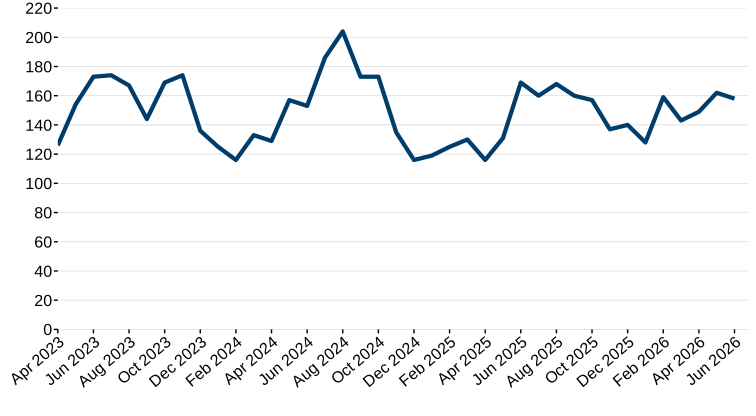
Description of figure 6: a line chart displaying the fluctuation in the number of rough sleepers throughout the year. Numbers peaked at 204 in August 2024 and dropped to a low of 116 in February 2024, December 2024 and April 2025.
Source: Welsh local authority homelessness services
Rough sleepers by local authority (StatsWales)
On 30 June 2026, there were 158 individuals estimated to be sleeping rough. This is lower than the number recorded on 30 June 2025 and 30 June 2023 but higher than that recorded on 30 June 2024.
The local authorities reporting the highest numbers of individuals sleeping rough were Cardiff (39), Pembrokeshire (24), Torfaen (19), Bridgend (16) and Ceredigion (14). All other local authorities reported 8 or fewer individuals sleeping rough, with 4 local authorities reporting zero.
Footnotes
[1] Neath Port Talbot’s ‘other’ figures are for households and not individuals.
[2] Disclosure control has been applied to the figures for placements into temporary accommodation and to accompanying data on StatsWales. Figures smaller than 3 have been supressed and shown as a ‘*’. All other figures are rounded independently to the nearest 3.
[3] Vale of Glamorgan’s October 2025 data has been used to estimate occurrences of people placed into temporary accommodation for November 2025 onwards. This includes the type of temporary accommodation and reason for homelessness. Please see the quality and methodology section for more information.
[4] Vale of Glamorgan’s October 2025 data has been used to estimate the number of homeless individuals moved into suitable long-term accommodation for November 2025 onwards. Please see the quality and methodology section for more information.
[5] Vale of Glamorgan’s October 2025 data has been used to estimate the number of rough sleepers, for November 2025 onwards. This is likely to have little impact on the Wales total for these months, as Vale of Glamorgan have reported zero rough sleepers since September 2023, and did so again in October 2025.
[6] Local authorities are asked to base these estimates on local intelligence, rather than a one-night count.
Quality and methodology information
This monthly data collection was introduced during the coronavirus (COVID-19) pandemic initially as Management Information. These data have since undergone the appropriate quality assurance protocols for Official Statistics. The data may be revised in future. Therefore, the figures for the latest month should be treated as provisional.
Following the introduction of this collection, Welsh Government worked with local authorities to develop this publication and to strengthen the data collection guidance and improve data quality. As a result of this development, data quality improved from April 2023; therefore, the Wales-level data series starts from this time point. Not all data is available at local authority level from this date. Local authority breakdowns are provided from the point where relevant guidance had been introduced and used by local authorities.
We do not recommend making month-to-month comparisons, as there may be seasonal impacts on homelessness or other reasons for fluctuations.
Most statistics in this release refer to number of individuals. However, for placements into temporary accommodation the statistics refer to number of occurrences of placements, as individuals may be placed more than once.
The Homelessness accommodation provision and rough sleeping quality report accompanies this statical release and is available on this website. The report provides detailed information on the data sources, methodology, and quality considerations, helping users to better understand and interpret the statistics.
Due to an unexpected system disruption following an upgrade, Vale of Glamorgan have not provided data since October 2025. In agreement with the local authority, their October 2025 data has been used as an estimate for all subsequent months. This applies to the following measures:
- occurrences of people placed into temporary accommodation during the month
- homeless individuals living in temporary accommodation at the end of the month
- homeless individuals moved into suitable long-term accommodation during the month
- number of rough sleepers
Revisions
Where revisions have occurred since the publication of last month’s data, figures will differ from those previously published. Figures that have been revised since previously published are marked with an [r].
This month there have been no revisions to previous data.
Statutory homelessness
It is important to note the following differences between this monthly data collection and our publications on statutory homelessness.
The monthly information relates to the number of individuals experiencing homelessness and being supported by local authorities into emergency accommodation or suitable long-term accommodation.
Our collections on statutory homelessness capture data on number of households, not individuals. That data relates to homelessness as defined by the Housing (Wales) Act 2014 (UK legislation).
Rough sleeping
For this data collection, local authorities are asked to base their estimates on local intelligence, rather than the methodology employed for the previous rough sleeper counts.
In August 2024, the previous Welsh Government made the decision to cease the annual national rough sleeper count with immediate effect. Further details can be found in the Proposals to stop the annual national rough sleeper count: summary of responses.
Due to the different methodologies, it is not appropriate to compare rough sleeping figures from this monthly collection with those from previous annual rough sleeper counts.
Statutory homelessness statistics for the other UK countries
In June 2025, the Office for National Statistics (ONS) published Homelessness in the UK: 2004 to 2024 (ONS). This provides a comprehensive overview of homelessness trends and the comparability of data across the 4 nations in the UK. The report highlights that while efforts have been made to improve the coherence of homelessness statistics, significant differences remain due to the devolved nature of housing and homelessness legislation.
Each UK country continues to collect and report homelessness data based on its own legal definitions and administrative systems, which limits the ability to make direct comparisons. Although broad trends can be compared, there is still no harmonised definition of homelessness for UK official statistics. The report builds on earlier work by the Government Statistical Service (GSS), which in 2019 published the Harmonisation of Definitions of Homelessness for UK Official Statistics: A Feasibility Report (GSS). This concluded that harmonisation was not feasible in the short term due to these structural differences.
Individual level data collection
Currently, homelessness data in Wales is gathered through aggregate returns from local authorities. These provide information on households applying for housing assistance and the outcomes of those applications. Work is ongoing to transition to a new data collection approach that will capture individual-level data on homelessness applicants. We believe this shift will enhance our understanding of homelessness in Wales and ultimately support efforts to improve outcomes for vulnerable individuals.
A data pilot took place at the end of 2025, with a small selection of local authorities, to simulate the proposed quarterly data collections. Following this, it was agreed that the new data collection would not fully ‘go-live’ from the original April 2026 launch date. Instead, we will continue to pilot the new collection in phased stages between April 2026 and April 2027. This will give time to improve data quality, complete General Data Protection Regulation (GDPR) requirements, and further develop systems.
Statement of compliance with the Code of Practice for Statistics
All of our statistics are produced and published in accordance with a number of statements and protocols to enhance trustworthiness, quality and value. These are set out in the Welsh Government’s Statement of Compliance.
These official statistics demonstrate the standards expected around trustworthiness, quality and public value in the following ways.
Trustworthiness
These statistics are based on monthly returns directly from local authority homelessness services. Figures are checked and queried where necessary by Welsh Government statisticians.
Quality
The published figures provided are compiled by professional analysts using the latest available data and applying methods using their professional judgement and analytical skillset. Statistics published by Welsh Government adhere to the Statistical Quality Management Strategy which supplements the Quality pillar of the Code of Practice for Statistics (UK Statistics Authority) and the European Statistical System principles of quality for statistical outputs.
Most of the data included comes from administrative sources which are used in the management of homelessness services. The data is dependent on local authorities maintaining accurate records.
Further information on data quality is available in the quality report.
Value
The purpose of the statistical release is to provide evidence for policy development, support the effective implementation of the Homelessness and Social Housing Allocation (Wales) Act 2026, enable local authorities to monitor and benchmark their services against those of other local authorities in Wales, and inform the public about homelessness provision and rough sleeping across Wales.
The release is as timely as possible whilst maintaining reliability, with generally around a 2-month lag between the data currency and availability. Making this information available monthly provides a regular source of data on the provision of homelessness accommodation and rough sleeping.
Well-being of Future Generations Act (WFG)
The Well-being of Future Generations Act 2015 is about improving the social, economic, environmental and cultural wellbeing of Wales. The Act puts in place seven wellbeing goals for Wales. These are for a more equal, prosperous, resilient, healthier and globally responsible Wales, with cohesive communities and a vibrant culture and thriving Welsh language. Under section (10)(1) of the Act, the Welsh Ministers must (a) publish indicators (“national indicators”) that must be applied for the purpose of measuring progress towards the achievement of the wellbeing goals, and (b) lay a copy of the national indicators before Senedd Cymru. Under section 10(8) of the Well-being of Future Generations Act, where the Welsh Ministers revise the national indicators, they must as soon as reasonably practicable (a) publish the indicators as revised and (b) lay a copy of them before the Senedd. These national indicators were laid before the Senedd in 2021. The indicators laid on 14 December 2021 replace the set laid on 16 March 2016.
Information on the indicators, along with narratives for each of the wellbeing goals and associated technical information is available in the Wellbeing of Wales report.
The statistics included in this release could also provide supporting narrative to the national indicators and be used by public services boards in relation to their local wellbeing assessments and local wellbeing plans.