
Gwyddoniaeth Ymchwil Tystiolaeth: modelu'r gaeaf 2026 i 2027 - Part 5: emergency department attendances and ambulance calls
Mae'r papur hwn yn darparu senarios wedi'u modelu ar gyfer ffliw, COVID-19 a feirws syncytiol anadlol (RSV) ar gyfer tymor y gaeaf sydd i ddod.
Ar y dudalen hon
Emergency department attendance
The ED attendances are defined as the daily number of unplanned visits to a hospital Emergency Department (ED), Minor Injury Unit (MIU), or equivalent urgent care setting for respiratory illness.
In the 2025 to 2026 winter, there were:
- 49,320 ED attendances due to respiratory problems
- 51,841 attendances in 2024 to 2025
- 50,508 attendances in 2023 to 2024
Attendances peaked at 307 in the first week of January 2025, broadly in line with the timing seen in previous seasons. (See Figure 28)
Modelled ED attendance scenarios for 2026 to 2027 winter period using three different scenarios shows that:
- the expected highest peak will occur on 30 December 2026 with an expected peak of 417 attendances
- one scenario projects a peak of 301 on 26 December 2026
- one scenario projects a peak of 262 attendances on 31 December 2026
(See Figure 29)
Figure 28: 7-day rolling average of daily ED attendances due to respiratory problems, between January 2019 and March 2026
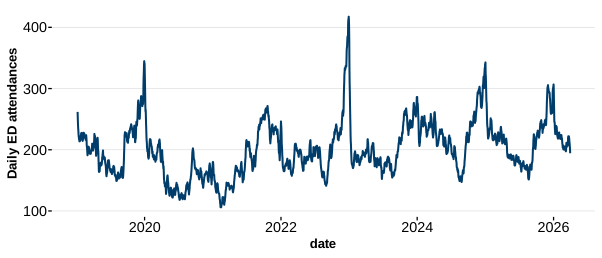
Description of Figure 28: A 7-day rolling average of daily ED attendances attributed to respiratory problems across Wales, between January 2019 and March 2026.
Source: Digital Health and Care Wales (DHCW)
Figure 29: Daily ED attendances due to respiratory problems scenarios – between September 2026 and March 2027
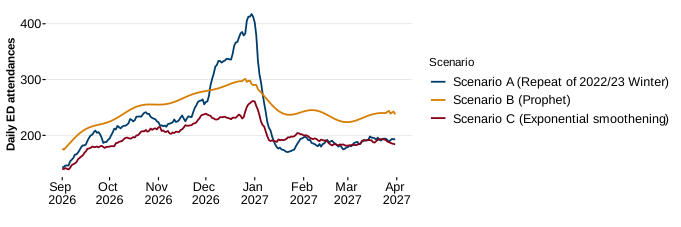
Description of Figure 29: A line chart with three scenarios representing projected daily emergency department attendances (due to respiratory problems), during Winter 2026 to 2027.
Source: SRE calculations using data provided by DHCW
Ambulance calls due to breathing problems
NHS Wales 999 (ambulance) call data provides a further indicator of respiratory illness burden in the community, capturing the more acute end of demand than the NHS 111 service.
Calls to 999 due to breathing problems are monitored throughout the winter period as part of the wider respiratory surveillance framework in Wales.
This section presents historical trends in daily 999 call volumes at Wales level and modelled scenarios for the 2026 to 2027 winter period.
As with 111 calls, it is important to note that 999 call data reflect community-level demand and are not directly comparable to hospital-based metrics; a single caller may contact the service more than once, and not all calls result in conveyance to hospital or onward referral to secondary care.
Figure 30 shows the 7-day rolling average of daily 999 calls attributed to respiratory problems across Wales from April 2021 to March 2026.
Call volumes display a seasonal pattern, with peaks occurring predominantly during the winter months of December and January each year.
The most pronounced peak in the series occurred in the winter of 2021 to 2022, reaching approximately 319 daily 999 calls, since when successive winter peaks have been progressively lower, consistent with the downward trend seen across the other respiratory indicators.
Figure 31 shows the three scenarios for the period September 2026 to March 2027.
- Under Scenario A, daily 999 calls are projected to peak at approximately 254 calls per day in late December 2026, the highest of the three scenarios.
- Scenario B projects a peak of approximately 202 calls per day.
- Scenario C projects a peak of approximately 141 calls per day.
Scenarios B and C both continue the recent downward trend.
As with the 111 call series, all three scenarios concentrate their peak demand around the turn of the year, coinciding with the Christmas and New Year period.
Figure 30: 7-day rolling average of daily 999 calls (Ambulance calls) due to respiratory problems between April 2021 and March 2026
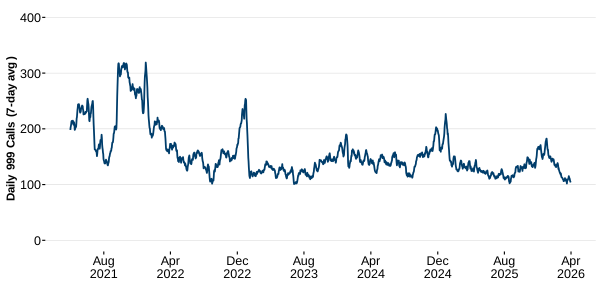
Description of figure 30: a line chart showing the 7-day rolling average of daily 999 calls.
Source: Welsh Ambulance Service University NHS Trust (WAST)
Figure 31: Number of 999 calls (Ambulance calls) due to respiratory problems scenarios– between September 2026 and March 2027
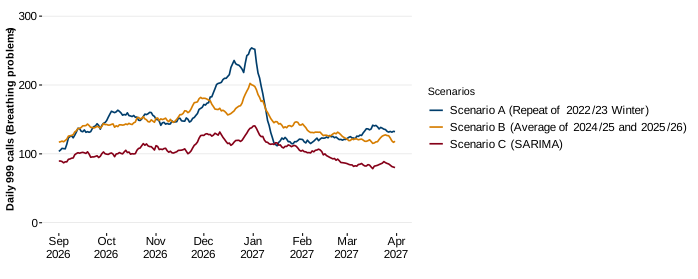
Description of figure 31: A line chart representing different projected daily 999 calls relating to breathing problems scenarios for Winter 2026 to 2027.
Source: SRE calculations using data provided by WAST