Grantiau Dysgu Llywodraeth Cymru (addysg bellach): Medi 2024 i Awst 2025
Data yn ôl oedran, awdurdod lleol, dull astudio ac incwm gweddilliol ar gyfer Medi 2024 i Awst 2025. Saesneg yn unig.
Ar y dudalen hon
Introduction
Welsh Government Learning Grants for Further Education (WGLG) provide extra money for eligible further education (FE) students aged 19 or over who might otherwise experience financial difficulty when undertaking post-compulsory education courses.
The data included here are obtained from the Student Loans Company (SLC). Unless otherwise stated, figures are for the 2024 to 2025 academic year, as at the end of July 2025.
The academic year begins on 1 September and ends on 31 August the following year. For example, the academic year 2024 to 2025 begins on 1 September 2024 and ends on 31 August 2025.
Notes on the data
- Throughout the bulletin, data has been rounded to the nearest five.
- Totals and percentages have been calculated using unrounded data, so a total may not equal the sum of its parts.
- The data for 2024 to 2025 academic year was extracted on 12th of January 2026 and is accurate as of that date.
Main points
- £2.8m was paid out in WGLGs to FE students in the 2024 to 2025 academic year compared with £3.3m paid out in the 2023 to 2024 academic year.
- 3,240 students applied for a WGLG in the 2024 to 2025 academic year; of these 2,515 (78%) applications were successful.
- 2,325 successful applications were from full-time students and 185 were from part-time students.
- The number of applications for a WGLG decreased by 19% between the 2023 to 2024 academic year and the 2024 to 2025 academic year. The number of successful applications decreased by 18% for the same period.
- 1,820 (78%) of successful full-time applications and 150 (80%) of successful part-time applications were from students with an income of £6,120 or less and were therefore eligible for the full grant amounts of £1,500 and £750 respectively.
Policy and operational context
This statistical bulletin includes data on the Welsh Government Learning Grants for Further Education (WGLG). Information on WGLG for Higher Education is published by the Student Loans Company in the Statistical First Release Student Support for Higher Education in Wales.
WGLGs were introduced by the Welsh Government from academic year 2002 to 2003 to provide extra money for students who might otherwise experience financial difficulty when undertaking post-compulsory education courses.
Initially the scheme only included students studying at further education institutions or higher education institutions. From the 2003 to 2004 academic year the scheme was extended to include students at all learning centres (e.g. schools) providing Education and Learning Wales or Local Education Authority facilitated courses. From the 2006 to 2007 academic year responsibility for the administration of applications of WGLG for students at further education institutions was transferred from local authorities to the Student Loans Company (SLC). Students qualify for the scheme if they are 19 or older, on an eligible course and meet the rest of the criteria (see Notes section for further information).
The number of WGLG awards is influenced by both the number of learners in post‑16 education and changes in household income, which can be affected by minimum wage levels and employment trends. Household income for means‑tested grants is assessed based on the highest income within the applicant’s household—this may be the applicant or their partner (if applicable), or, for younger applicants, the applicant’s parent(s) or parent(s) and their partner.
Students can receive payments of up to £1,500 if they are in full-time education or up to £750 if they are in part-time education.
Further information on WGLG for FE students is on the Student Finance Wales website.
Student Finance Wales is the service that processes applications and assesses eligibility for student loans and grants on behalf of the Welsh Government, ensuring students in Wales receive the correct funding. The Student Loans Company, by contrast, is the UK‑wide organisation that administers the actual payments and manages loan repayments, including maintaining borrower accounts and collecting repayments through the tax system. Data used here is administrative data provided by SLC on WGLG for Further Education.
Applications by application status and mode of study
There has been a general downward trend in total WGLG applications since the 2014 to 2015 academic year. Over that same time, successful applications as a proportion of FE learners aged over 18 years old have fallen (see Figure 5). This suggests the fall in WGLG applications is not just reflecting changes in the learner population.
The maximum income band for successful claims has been frozen at £18,370 since the 2011 2012 academic year. The real-terms fall in this band may have led to fewer learners applying. Information on learner numbers by age and gender can be found on StatsWales.
Figure 1: applications by application status and the percentage of applications that were successful
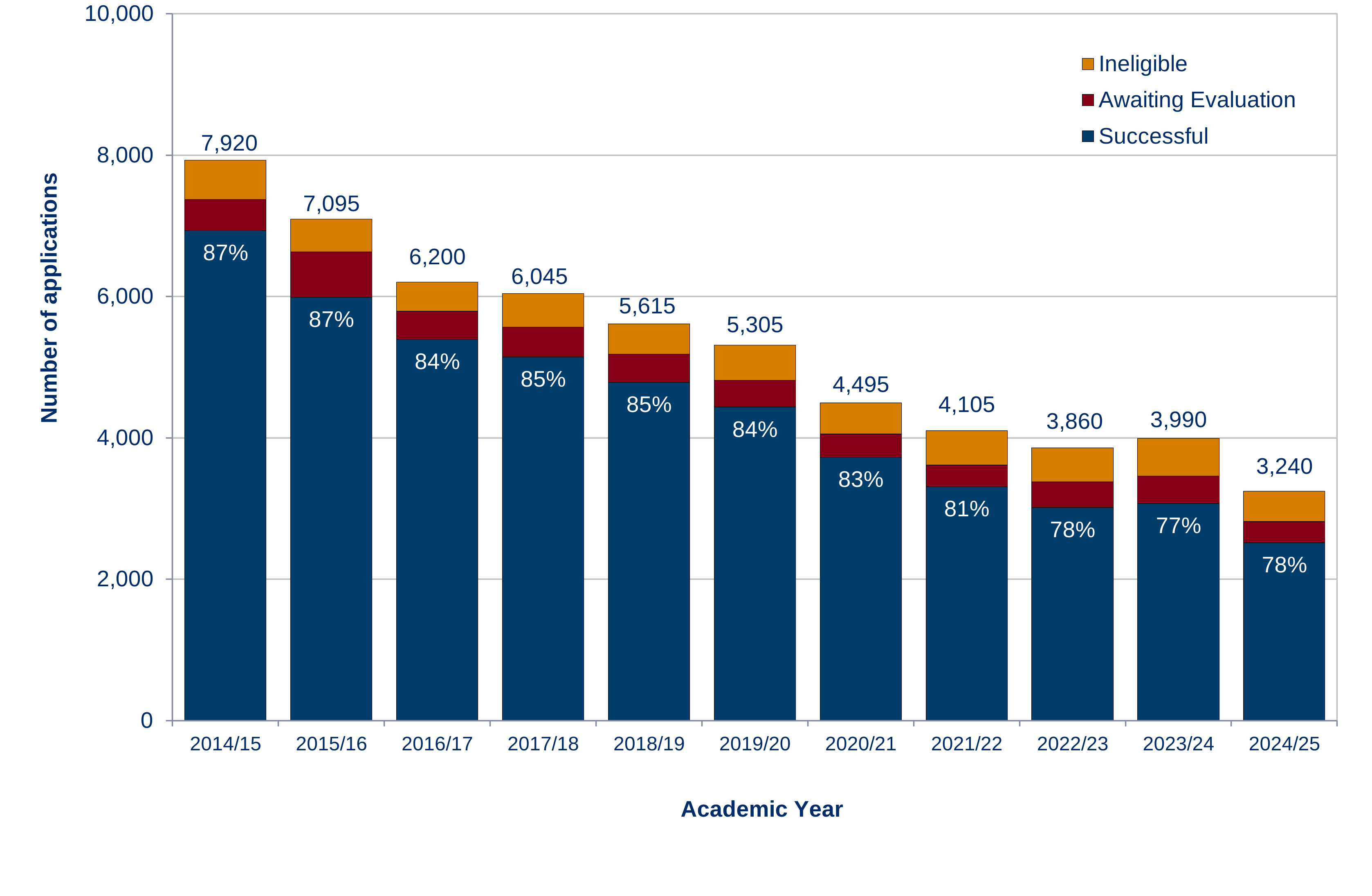
Description of figure 1: a bar chart showing the total number of applications and the percentage of successful applications for a WGLG from the 2014 to 2015 academic year to the 2024 to 2025 academic year. Numbers have decreased from 7,920 in the 2014 to 2015 academic year to 3,240 in the 2024 to 2025 academic year. The percentage of successful applications has decreased from 87% in the 2014 to 2015 academic year to 78% in the 2024 to 25 academic year.
Source: Student Loans Company.
In the 2024 to 2025 academic year:
- there were 3,240 applications for WGLG, a decrease of 19% compared to the previous academic year
- 2,515 of these were successful applications, a decrease of 18% compared to the previous academic year
Figure 2 shows the percentage of learners in further education that receive WGLG. This chart uses the Lifelong Learning Wales Record (LLWR) for student numbers. This data is available on StatsWales: Unique learner numbers by age and gender.
Figure 2: percentage of FE learners aged 19 or over successfully claiming WGLG [Note 1]
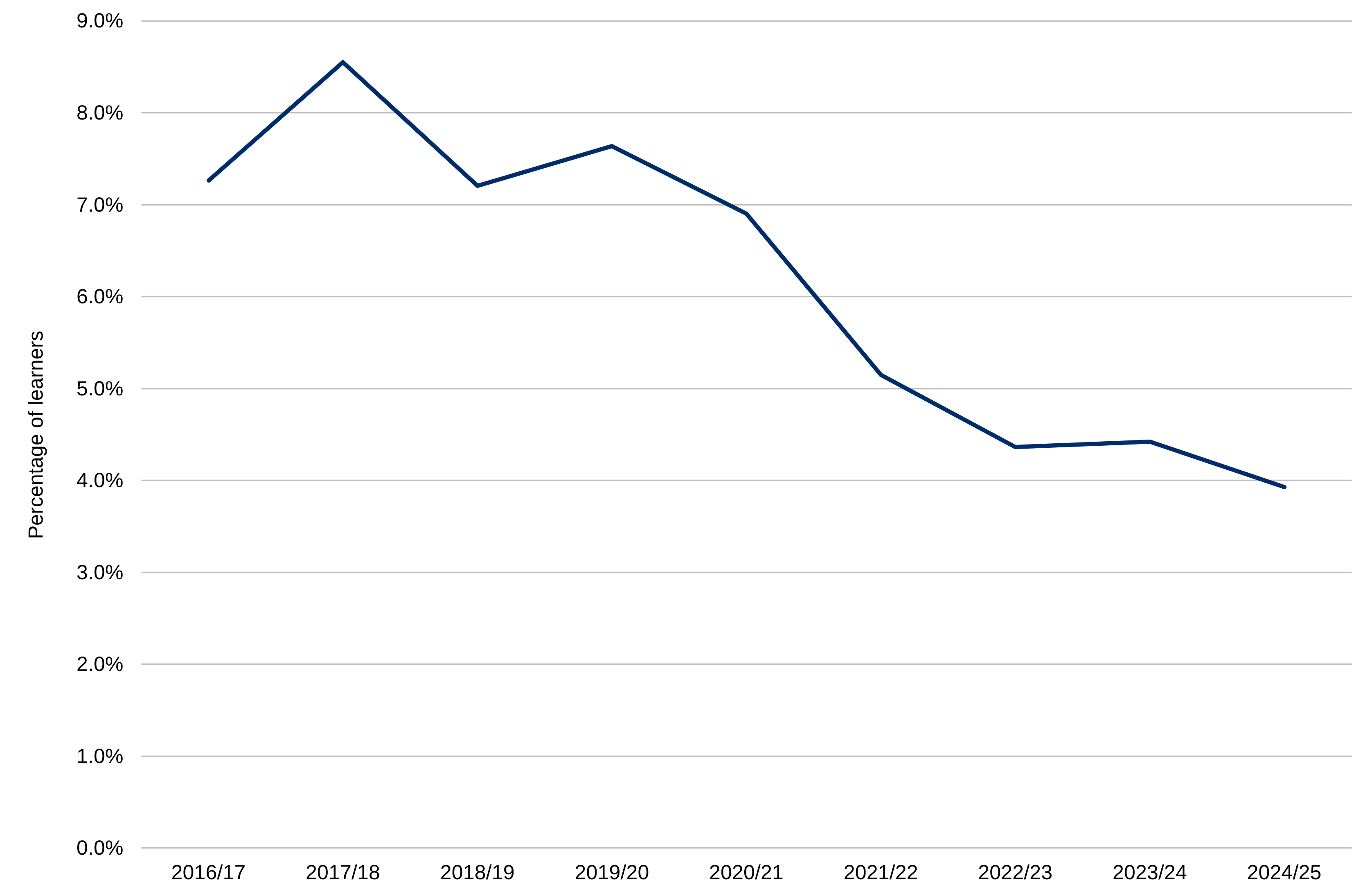
Description of figure 2: A line graph showing the percentage of learners aged 19 or over who successfully claim a WGLG. The percentage was 8.6% in 2017 to 2018 academic year, decreasing to 3.9% 2024 to 2025 academic year.
[Note 1]: The number of learners aged 19 or over has been updated to reflect the removal of apprentices from the data as they are not eligible to receive a Welsh Government Learning Grant.
[Note 2]: Learners studying at schools are not included in the FE learner numbers
Source: Student Loans Company and LLWR.
Since the 2015 to 2016 academic year the percentage of learners aged 19 or over receiving WGLG has generally been declining from 8.6% in 2017 to 2018 academic year, decreasing to 3.9% 2024 to 2025 academic year. This could be due to household income bands being frozen since the 2011 to 2012 academic year.
Successful applications by mode of study
Figure 3: successful applications by mode of study and the percentage of applications from full-time students [Note 1]
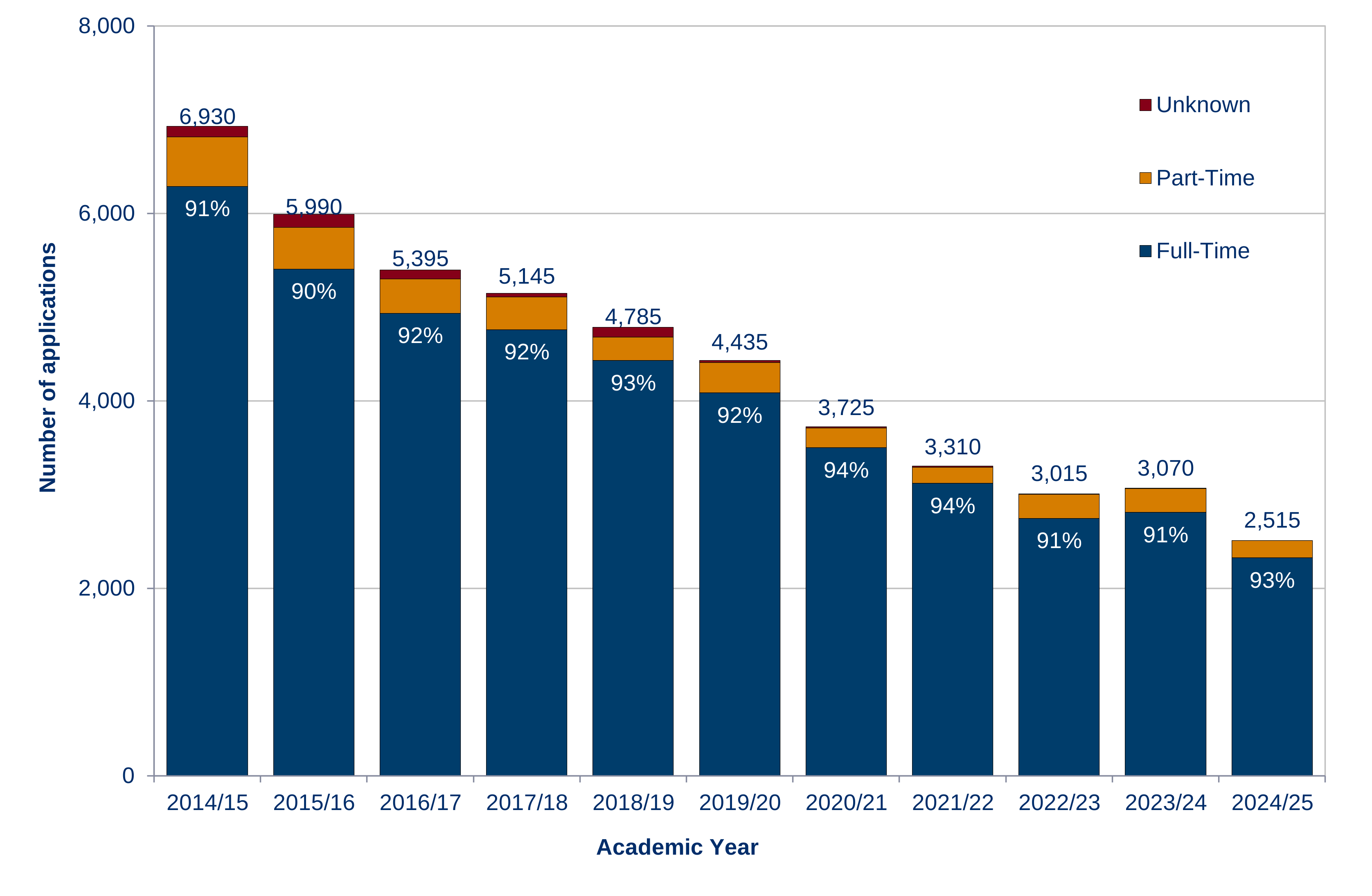
Description of figure 3: A bar chart showing the number of successful applications for a Welsh Government Learning Grant and the proportion of these which were for full time study between the 2014 to 2015 academic year and the 2024 to 2025 academic year. The number of successful applications decreased from 6,930 in the 2014 to 2015 academic year to 2,515 in the 2024 to 2025 academic year. The percentage of applications that were for full time study was between 90% and 94%.
Source: Student Loans Company.
[Note 1] Part-time applications include applications where the course of study is below the band of taught hours (less than 275 hours per year).
There were 2,515 successful applications in the 2024 to 2025 academic year; of these:
- 2,325 were from full-time students, a decrease compared to the 2023 to 2024 academic year. 93% of all successful applications were from full-time students
- 185 of successful applications were from part-time students, a decrease from 255 in the 2023 to 2024 academic year. 7% of all successful applications were from part-time students
- there were also some applications from students where it was unknown if they were full or part-time and most of those applications were unsuccessful
Successful applications by sex
Figure 4: successful applications by sex
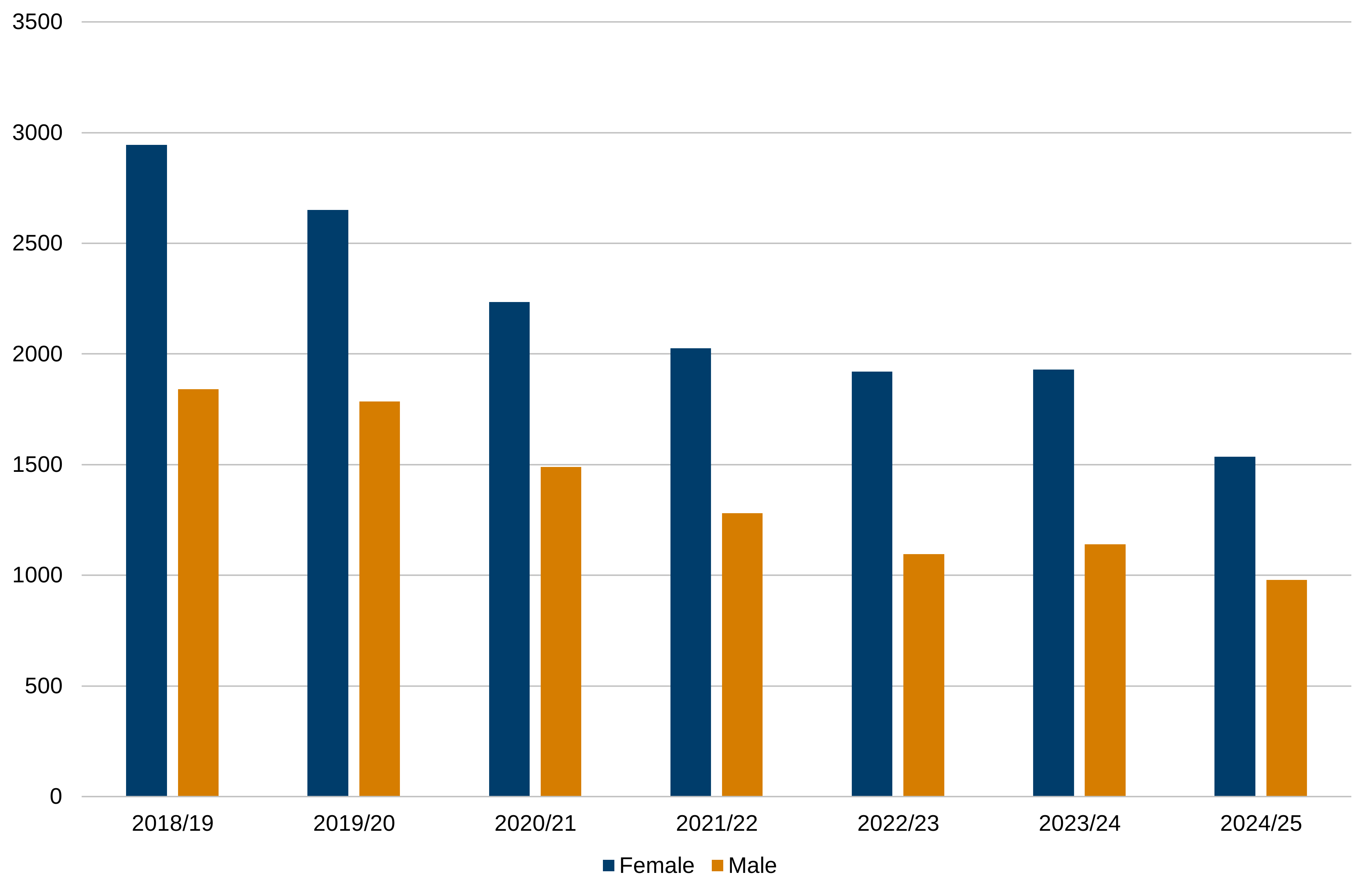
Description of figure 4: a bar chart showing successful applications by sex between the 2018 to 2019 academic year and the 2024 to 2025 academic year. Successful applications from females decreased from 2,945 in the 2018 to 2019 academic year to 1,535 in the 2024 to 2025 academic year. For males, successful applications decreased from 1,840 in the 2018 to 2019 academic year to 980 in the 2024 to 2025 academic year.
Source: Student Loans Company.
In the 2024 to 2025 academic year, 61% (1,535) of successful applications for WGLG were from female students, but this should be considered in the context of learner demography: in the 2024 to 2025 academic year (Unique learner numbers by age and gender (StatsWales)), 53% of learners aged 19 or over were female.
Successful applications by local authority
Figure 5: successful applications by local authority and mode of study, 2024 to 2025 academic year
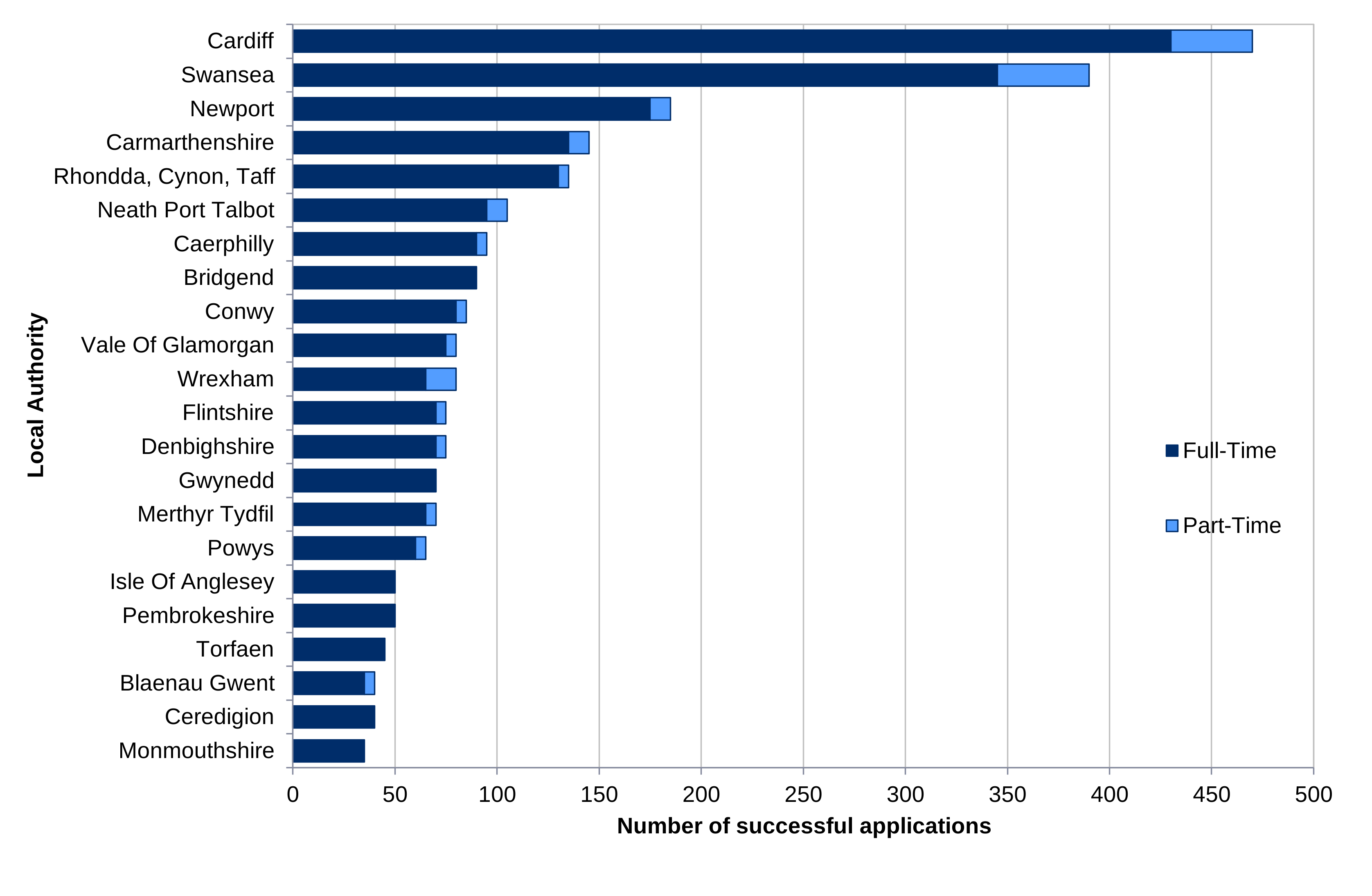
Description of figure 5: This bar chart displays the number of successful Welsh Government Learning Grant applications by local authority. Cardiff, with 470, and Swansea, with 390, are the local authorities with the greatest number of successful applications. Monmouthshire and Ceredigion are the local authorities with the smallest number of successful applications, with 35 and 40 respectively.
Source: Student Loans Company.
In the 2024 to 2025 academic year:
- the number of all successful applications (including both full-time and part-time) ranged from 35 in Monmouthshire to 470 in Cardiff
- Cardiff accounted for 19% of all full-time successful and 23% of all part-time successful applications
- the local authority with the highest proportion of part-time learners amongst their successful applications was Wrexham at 17%
Successful applications by nationality and residency status
When a student applies for the Welsh Government Learning Grant (WGLG), the Student Loans Company (SLC) collects detailed nationality and residency information to ensure applicants meet the eligibility criteria set by Welsh Government. These categories refer to the eligibility criteria as provided in the Student Loans eligibility guide (Student Finance Wales).
| Nationality and residency status | Number of Applications | Percentage |
|---|---|---|
| UK/Irish and Settled Citizens | 1450 | 58% |
| EU/EEA/Swiss | 85 | 3% |
| Protection & Humanitarian Routes | 840 | 33% |
| Other | 5 | 0% |
| Family and Private Life | 40 | 2% |
| Total | 2515 | 100% |
Table 1 shows the number of successful applications by their nationality and residency status.
Source: Student Loans Company.
[Note 1] As this is the first year publishing this data we do not have the previous year’s data to compare.
More information about the classification of nationality and residency status is given in the definitions section.
Of all successful applications for WGLGs, 1,450 (58%) were submitted by applicants with UK/Irish nationality status. A further 85 applications (3%) were from individuals with EU/EEA/Swiss status. Meanwhile, applicants from protection and humanitarian routes accounted for 840 successful applications (33%).
Amount paid by household income band
Calculation of amount of award is based on the household income. Household income refers to the highest income of you or the relevant parent(s)/partner, depending on your circumstances. See Guide to Welsh Government Learning Grant Further Education 2024/25 (Student Finance Wales) for more information.
| Household income | Full-time (2023/24) | Part-time (2023/24) | Total (2023/24) | Full-time (2024/25) | Part-time (2024/25) | Total (2024/25) |
|---|---|---|---|---|---|---|
| £0 - £6,120 | £2,950,000 | £145,000 | £3,095,000 | £2,385,000 | £100,000 | £2,485,000 |
| £6,121 - £12,235 | £230,000 | £10,000 | £235,000 | £210,000 | £10,000 | £220,000 |
| £12,236 - £18,370 | £80,000 | £5,000 | £80,000 | £70,000 | £5,000 | £75,000 |
| All income bands | £3,255,000 | £155,000 | £3,410,000 | £2,665,000 | £115,000 | £2,780,000 |
Description of table 2: a table showing the amount of WGLG paid by household income band and mode of study.
Source: Student Loans Company.
[Note 1] Most of the payments will be associated with applications that are successful. Some however are currently in a state other than "Successful".
[Note 2] Includes small amounts paid to those with income since identified as "£18,371+". All figures have been rounded to the nearest 5.
- £2.8 million was paid in WGLGs to FE students in the 2024 to 2025 academic year, a decrease of 19% compared to the £3.4 million paid in the 2023 to 2024 academic year.
Notes
Welsh Government Learning Grant for Further Education eligibility criteria
The grant is available to eligible students studying in Wales or elsewhere in the UK. For a grant to be awarded both the student and course criteria must be satisfied. The Welsh Government Learning Grant for Further Education (WGLG) scheme has various student and course criteria, as follows.
Student criteria
- Nationality and residency: UK citizens living in Wales may be eligible for WGLG. Students living in Wales who are not UK citizens may still be eligible to get WGLG; more information can be found on the Student Finance Wales website.
- Age: 19 or over on 1 September.
Course criteria
Students do not have to study in Wales to get WGLG but must be studying at a school or college to be eligible for the WGLG scheme.
The course must:
- require attendance for at least 275 hours during the academic year
- be at an eligible school or college
- lead to a nationally recognised qualification, up to and including Level 3 qualifications
Calculation of amount of award is based on the income of the student or student’s family. Household income is calculated by taking gross income (before tax and National Insurance) and deducting certain allowances. Household income for means‑tested grants is assessed based on the highest income within the applicant’s household; this may be the applicant or their partner (if applicable), or, for younger applicants, the applicant’s parent(s) or parent(s) and their partner.
The income bands have remained frozen since the 2011 to 2012 academic year.
| Academic Year | Upper Grant Eligibility | Middle Grant Eligibility | Lower Grant Eligibility |
|---|---|---|---|
| 2011/12 onwards | £0 to £6,120 | £6,121 to £12,235 | £12,236 to £18,370 |
| 2010/11 | £0 to £5,895 | £5,896 to £11,790 | £11,791 to £17,700 |
| 2009/10 | £0 to £5,895 | £5,896 to £11,790 | £11,791 to £17,700 |
| 2008/09 | £0 to £5,745 | £5,746 to £11,490 | £11,491 to £17,250 |
| 2007/08 | £0 to £5,605 | £5,606 to £11,210 | £11,211 to £16,830 |
| 2006/07 | £0 to £5,475 | £5,476 to £10,945 | £10,946 to £16,435 |
For all FE students, where a student is on an eligible course, awards are calculated on the following basis.
| Contact hours in the academic year | Household income £0 to £6,120 | Household income £6,121 to £12,235 | Household income £12,236 to £18,370 | Household income £18,370 or over |
|---|---|---|---|---|
| 275 to 499 (part to time) | £750 | £450 | £300 | Nil |
| 500 or more (full to time) | £1,500 | £750 | £450 | Nil |
Source: Student Loans Company.
Data source
WGLG applications and payments are administered by Student Finance Wales.
Data held on WGLG students is entered by SLC staff onto an administrative database for the purpose of assessing and paying WGLG to students. This data is also stored in a management information data warehouse for the purpose of management reporting, operational performance reporting, audit of processes, statistics, future policy planning and forecasting.
These statistics make use of that data to report on important aspects of the scheme.
- Trends in applications and approvals.
- Age, sex and mode of study.
- Applications in income bands.
- Learning centre type.
- Local authority.
Detailed analyses are available in this annual Bulletin and data published on StatsWales.
Data collection
The data in this release were collected via the SLC management information system and were extracted on 12 January 2026. All information is based on applications received by 31 July 2025.
Validation and verification
Processes and systems which enable customer and application assessment data to be held electronically are subject to periodic audit and integrity checks. SLC Internal Audit ensures that the processes governing data entry and application assessment are adhered to. Data integrity validation rules are used to identify and correct errors in data. Management Information extracted from SLC systems are subject to quality assurances prior to distribution: statisticians within the Welsh Government review the data and query any anomalies with the SLC before tables are published.
Publication
Once the data has been finalised, the release is compiled, and the key points and commentary are drafted. The release is independently checked, and a final sense check is carried out by the relevant statistician prior to publication on the website.
Disclosure control and confidentiality
All the figures are rounded to the nearest 5 for confidentiality. Due to rounding, the sums of some rows or columns may not add to the total figure given.
Definitions
Application status
Application status refers to the stage an application has reached in the Student Loans Company (SLC) decision process. Each application is assigned a status that indicates whether it has been approved, rejected, or is still being assessed. Using application status allows us to report not only the volume of Welsh Government Learning Grant (WGLG) applications received, but also how many progressed to a successful award and how many did not. This helps to provide clearer insight into trends in application decisions over time.
Nationality and Residency Status
When a student applies for the WGLG, the SLC collects detailed nationality and residency information to ensure applicants meet the eligibility criteria set by Welsh Government. The application form asks students to confirm their nationality, immigration status and three years ordinary residence history, starting with whether they hold a valid UK passport, are an Irish citizen, or are a family member of a UK national.
- UK/Irish and Settled Citizens refers to UK citizens and Irish citizens, as well as their eligible family members and non British nationals with Indefinite Leave (including Indefinite Leave to Remain or Enter), not including those with EUSS Settled Status. These individuals do not require immigration permission to live in the UK and therefore form a distinct category separate from other migrant groups.
- EU/EEA/Swiss consists of EU, EEA and Swiss nationals, including those with EUSS Settled or Pre to Settled Status, as well as their family members. It covers all non British EU/EEA/Swiss citizens regardless of route.
- Protection & Humanitarian Routes includes individuals granted permission through Protection and Humanitarian Routes, including Conflict to Specific Schemes such as the Ukraine schemes, along with Afghan RAP/ACRS, Refugee Status, Humanitarian Protection, Stateless leave, Calais leave and Section 67 leave. Eligible family members are also included.
- Other covers forms of discretionary leave not linked directly to protection, such as following or outside of asylum processes, or Leave to Remain outside the immigration rules. These routes do not fall neatly under protection or family life categories.
- Family and Private Life includes individuals granted Leave to Remain based on their family relationships or private life in the UK. It covers those whose residence rights are based on Article 8 (family and private life) considerations, as well as their eligible family members.
These categories refer to the eligibility criteria as provided by Student Finance Wales.
Students who have withdrawn
The data represented in this release on successful applications refer to applicants who have been approved for a WGLG during the academic year. Students who have withdrawn from their course are not removed from the analysis. Furthermore, figures on successful applications represent the total value of the approved WGLG and have not been adjusted for unpaid or recovered instalments.
Awaiting evaluation
Applications ‘awaiting evaluation’ are incomplete, missing either information from the application or supporting evidence. At the cut to off date (31 July for the most recent year) the following were the approximate numbers.
| Academic Year | 2018/19 | 2019/20 | 2020/21 | 2021/22 | 2022/23 | 2023/24 | 2024/25 |
|---|---|---|---|---|---|---|---|
| Awaiting Evaluation | 400 | 380 | 330 | 305 | 365 | 390 | 300 |
Source: Student Loans Company.
Quality information
These statistics adhere to the Welsh Government’s Statistical Quality Management Strategy. They are produced in accordance with the Code of Practice for Official Statistics independently under the responsibility of the Welsh Government Chief Statistician.
They undergo regular quality assurance reviews to ensure that they meet customer needs. They are produced free from any political interference. Here are further details of how we adhere to the dimensions.
- Relevance (the degree to which the statistical product meets user needs for both coverage and content).
- Accuracy (the closeness between an estimated result and the (unknown) true value).
- Timeliness and punctuality (timeliness refers to the lapse of time between publication and the period to which the data refer, whilst punctuality refers to the time lag between the actual and planned dates of publication).
- Accessibility and clarity (accessibility is the ease with which users are able to access the data, also reflecting the format(s) in which the data are available and the availability of supporting information, whilst clarity refers to the quality and sufficiency of the metadata, illustrations and accompanying advice).
- Comparability and coherence (the degree to which data can be compared over time and domain and the degree to which data that are derived from different sources or methods, but which refer to the same phenomenon, are similar).
Relevance
The statistics are used both within and outside the Welsh Government to monitor educational trends and as a baseline for further analysis of the underlying data. Some of the main users are:
- ministers and the Members Research Service in the Senedd
- officials in the Welsh Government
- other government departments
- Further Education Institutions, Work to Based Learning providers, schools and local authorities
- Wales Audit Office
- students, researchers, academics and universities
- individual citizens, private companies, and the media
These statistics are used in a variety of ways. Some examples of these are:
- general background and research
- inclusions in reports, articles and briefings
- advice to ministers
- to inform and monitor the education policy development and decision to making process in Wales
- to forecast future expenditure of student support schemes in Wales
Accuracy
Statisticians within the Welsh Government review the data and query any anomalies with the SLC before tables are published. The figures in this release reflect the final position as at the end of the 2024 to 2025 academic year academic year (31 July 2025), and are correct as at 12 January 2026.
Timeliness and punctuality
The data in this statistical release is available in September, and the release is usually published in November. Publication of this release was postponed to February this year to allow sufficient time to compile and quality assure the data.
Accessibility and clarity
This statistical release is pre to announced and then published on the Statistics section of the Welsh Government website. It is accompanied by more detailed tables on StatsWales, a free to use service that allows visitors to view, manipulate, create and download data.
Comparability and coherence
Strengths
- Outputs have been developed to meet the internal and external user need in Wales.
- The data is derived from well to understood SLC systems.
- Detailed statistics are provided via our StatsWales website.
Limitations
- WGLG for Further Education has been available to students aged 19 and over at the start of the academic year since the academic year 2006 to 2007. Education Maintenance Allowance (EMA) is available for 16 to 18 year olds. Further information on EMAs was published in January 2026 in the statistical release Education Maintenance Allowances (EMA) awarded in Wales: September 2024 to August 2025.
Official statistics status
All official statistics should show the standards of the Code of Practice for Statistics.
These are accredited official statistics. They were independently reviewed by the Office for Statistics Regulation in May 2022. They comply with the standards of trustworthiness, quality and value in the Code of Practice for Statistics.
It is Welsh Government’s responsibility to maintain compliance with the standards expected of accreditation. If we become concerned about whether these statistics are still meeting the appropriate standards, we will discuss any concerns with OSR promptly. Accreditation can be cancelled or suspended at any point when the highest standards are not maintained, and reinstated when standards are restored.
Accredited official statistics are called National Statistics in the Statistics and Registration Service Act 2007.
Statement of compliance with the Code of Practice for Statistics
Our statistical practice is regulated by the Office for Statistics Regulation (OSR). OSR sets the standards of trustworthiness, quality and value in the Code of Practice for Statistics that all producers of official statistics should adhere to.
All of our statistics are produced and published in accordance with a number of statements and protocols to enhance trustworthiness, quality and value. These are set out in the Welsh Government’s Statement of Compliance.
These accredited official statistics (OSR) demonstrate the standards expected around trustworthiness, quality and public value in the following ways.
Since the latest review by the Office for Statistics Regulation, we have continued to comply with the Code of Practice for Statistics, and have made the following improvements.
- Replaced pie charts with bar charts making comparisons within and between charts easier.
- Introduced chart showing the successful applications by gender.
- Introduced a chart showing proportion of all learners successfully claiming WGLG over time.
- Replaced tables with charts to simplify the release and allow visualisation of the main messages, with tables available on StatsWales
- Introduced a description and link to the Wellbeing of Wales report.
- Improved accessibility by including alt text for charts and tables.
- Added graphics to the main points at the start of the release.
Well to being of Future Generations Act (WFG)
The Well to being of Future Generations Act 2015 is about improving the social, economic, environmental and cultural wellbeing of Wales. The Act puts in place seven wellbeing goals for Wales. These are for a more equal, prosperous, resilient, healthier and globally responsible Wales, with cohesive communities and a vibrant culture and thriving Welsh language. Under section (10)(1) of the Act, the Welsh Ministers must (a) publish indicators (“national indicators”) that must be applied for the purpose of measuring progress towards the achievement of the wellbeing goals, and (b) lay a copy of the national indicators before Senedd Cymru. Under section 10(8) of the Well to being of Future Generations Act, where the Welsh Ministers revise the national indicators, they must as soon as reasonably practicable (a) publish the indicators as revised and (b) lay a copy of them before the Senedd. These national indicators were laid before the Senedd in 2021. The indicators laid on 14 December 2021 replace the set laid on 16 March 2016.
Information on the indicators, along with narratives for each of the wellbeing goals and associated technical information is available in the Wellbeing of Wales report.
Further information on the Well to being of Future Generations (Wales) Act 2015.
The statistics included in this release could also provide supporting narrative to the national indicators and be used by public services boards in relation to their local wellbeing assessments and local wellbeing plans.
Further details
Tables associated with this bulletin containing a greater amount of detail are available on the Welsh Government’s interactive data dissemination service, StatsWales.
Further information about the WGLG (FE) scheme can be found on the Student Finance Wales website.
Information on WGLG HE is published in the Student Loans Company statistics ‘Student Support for Higher Education in Wales’.
We want your feedback
We welcome any feedback on any aspect of these statistics which can be provided by email to HigherEducationAndStudentFinance.Stats@gov.wales
Contact details
Higher education and finance statistics
Email: HigherEducationAndStudentFinance.stats@gov.wales
Media: 0300 025 8099
SFR 16/2026