Amcangyfrifon stoc annedd: ar 31 Mawrth 2025
Amcangyfrifon o’r nifer o anheddau (yn cynnwys rhai gwag) yng Nghymru a phob awdurdod lleol yn ôl daliadaeth, ar 31 Mawrth 2025. Saesneg yn unig.
Ar y dudalen hon
Main points
- There were an estimated 1,487,200 dwellings in Wales, an increase of 5% over the past decade.
- Owner-occupied stock has increased in the past 10 years and accounted for an estimated 71% (1,061,000) of all dwelling stock at 31 March 2025 (p).
- Privately rented stock has decreased in the past ten years and accounted for an estimated 12% (184,900) of all dwelling stock at 31 March 2025 (p).
- Registered social landlord stock has increased over the same time period and accounted for an estimated 10% (151,900) of all dwelling stock at 31 March 2025.
- Local authority stock has remained fairly stable since 2014 and accounted for an estimated 6% (89,400) of all dwelling stock at 31 March 2025.
- The proportion of dwelling stock accounted for by each tenure has remained almost constant since 2012.
In the main points, trends are considered across a ten-year period which is comparable for each tenure. For each individual tenure, trends are considered over the longest period for which comparable data are available.
All references to a specific year (e.g. 2014) in this release indicate the figure as at 31 March of that year.
Figure 1: estimated dwellings by tenure, as at 31 March 2025 [Note 1]
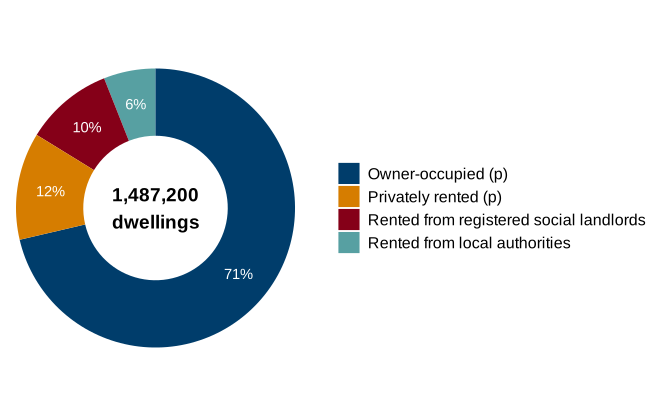
Description figure 1: a doughnut chart showing the percentage split of dwellings by tenure at 31 March 2025. Over two thirds of dwellings were owner-occupied.
Source: Welsh Government
Dwelling stock estimates percentages by year and tenure (StatsWales)
[Note 1] Owner-occupied includes intermediate tenure.
(p) Percentage of owner-occupied and privately rented stock are provisional and subject to revision following publication of the 2025 Annual Population Survey (APS) (please see the quality report).
Dwelling stock estimates in Wales
Estimates of the total number of dwellings are based on data from the population censuses, the latest of which was in March 2021. Estimates from the censuses are updated annually to take account of new house building and demolitions. The breakdown of dwelling stock estimates by tenure is estimated from local authority returns, registered social landlord returns and estimates from the APS. Further information on the methodology is outlined in the accompanying quality report.
At 31 March 2025 there were an estimated 1,487,200 residential dwellings in Wales. The number of dwellings differs from the number of households as there may be more than one household occupying a dwelling, some dwellings may be vacant, and others may be used as second residences.
The estimated dwelling stock in Wales has increased by 5% (71,200 dwellings) since 31 March 2015 and by 0.3% (4,600 dwellings) since 31 March 2024.
Between 2015 and 2025, there has been a 5% increase in private sector stock and an 8% increase in social sector stock.
Figure 2: dwelling stock estimates by tenure, as at 31 March each year, 2001 to 2025 [Note 1] [Note 2] [Note 3] [Note 4]
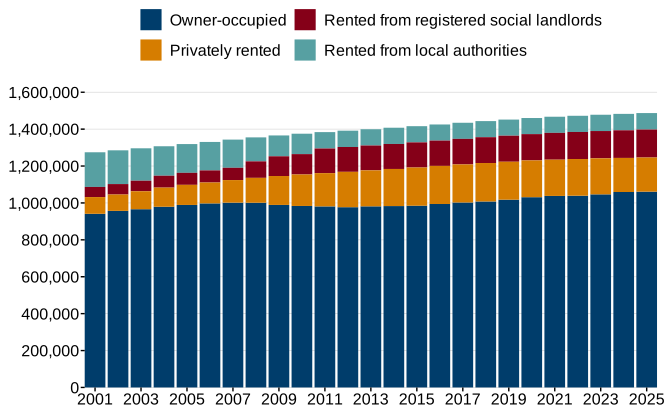
Description of figure 2: a stacked bar chart showing the number of dwellings for each tenure, as well as the Wales total, between 2001 and 2025. Dwellings in the private sector and those rented from registered social landlords have increased each year in this period, however, after a large decrease between 2001 and 2011, the number of dwellings rented from local authorities have remained fairly stable.
Source: Welsh Government
Dwelling stock estimates by year and tenure (StatsWales)
[Note 1] Owner-occupied includes intermediate tenure.
[Note 2] Historical comparisons should be treated with caution owing to the methodological improvements introduced to owner-occupied and privately rented estimates in 2019. These improvements have been applied to estimates from 2013 onwards.
[Note 3] Estimates of owner-occupied and privately rented stock for 2024 and 2025 are provisional and subject to revision following publication of the 2025 APS (please see the quality report).
[Note 4] Dwelling stock estimates for 2023 and 2024 have been revised following the publication of the 2024 APS.
Private sector stock
In 2019, methodological improvements were introduced to owner-occupied and privately rented estimates. These improvements have been applied to estimates from 2013 onwards, therefore, trends are only considered from 2013 onwards (please see the quality report for more details).
Owner occupied stock has increased year on year since 2013. Overall, between 31 March 2013 and 31 March 2025 it increased by 8% (79,400 dwellings). At 31 March 2025, there was an estimated 1,061,000 owner-occupied dwellings in Wales (based on provisional data). Since 31 March 2024, there has been an increase of 1,700 (less than 1%) in owner-occupied stock (based on provisional data).
Between 2013 and 2025, the number of privately rented stock decreased by 9,900 dwellings (5%). The total stock has fluctuated over the period, with a high of 208,300 in 2018 and a low of 184,600 in 2024. At 31 March 2025, there were an estimated 184,900 privately rented dwellings in Wales (based on provisional data). This is an increase of 300 (less than 1%) since 31 March 2024 (based on provisional data).
These estimates are calculated using the 2024 APS. The APS household dataset has some volatility and due to the coronavirus (COVID-19) pandemic, from March 2020, the mode of data collection for this survey changed, which resulted in a change in the characteristics of people who responded to the survey (please see the quality report for further details).
Social sector stock
Between 2010 and 2011, there was a 21% increase in the number of dwellings rented from registered social landlords and a 20% decrease in the number of dwellings rented from local authorities. This was largely owing to the large-scale transfer of local authority stock to registered social landlords between 2008 and 2011, therefore, trends are only considered from 2011 onwards (please see the quality report for more details).
Between 31 March 2011 and 31 March 2025, there has been an annual increase in registered social landlord stock, with the total stock increasing by 18,300 dwellings (14%). At 31 March 2025 there was an estimated 151,900 registered social landlord dwellings in Wales. Estimates of local authority stock decreased by 1,500 (2%) between 2011 and 2017. Between 2017 and 2025, local authority stock has increased by 2,100 (2%). At 31 March 2025, the estimated number of dwellings rented from local authorities was 89,400.
Figure 3: annual change in total dwelling stock by tenure, as at 31 March 2002 to 31 March 2025 [Note 1] [Note 2] [Note 3] [Note 4]
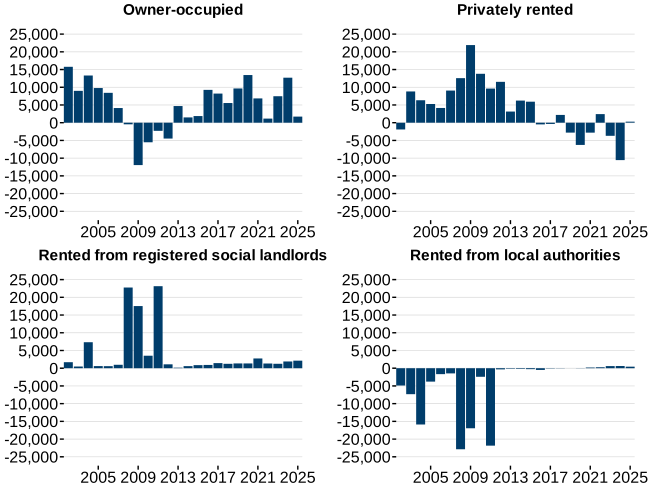
Description of figure 3: bar graphs showing that owner-occupied and privately rented dwellings have fluctuated between 2002 and 2025. Registered social landlord dwellings have increased each year and local authority dwellings have decreased each year before 2017 and slightly increased after 2017.
Source: Welsh Government
[Note 1] Owner-occupied includes intermediate tenure.
[Note 2] Historical comparisons should be treated with caution owing to the methodological improvements introduced to owner-occupied and privately rented estimates in 2019. These improvements have been applied to estimates from 2013 onwards.
[Note 3] Estimates of owner-occupied and privately rented stock for 2024 and 2025 are provisional and subject to revision following publication of the 2025 APS (please see the quality report).
[Note 4] Dwelling stock estimates for 2023 and 2024 have been revised following the publication of the 2024 APS.
Dwelling stock estimates by local authority area
Estimated dwelling stock in Wales increased by 4,600 (0.3%) between 31 March 2024 and 31 March 2025. Annual increases ranged from under 100 in 6 local authorities to 600 in Cardiff (0.4%).
Figure 4: dwelling stock estimates, percentages by tenure and local authority, as at 31 March 2025 [Note 1]
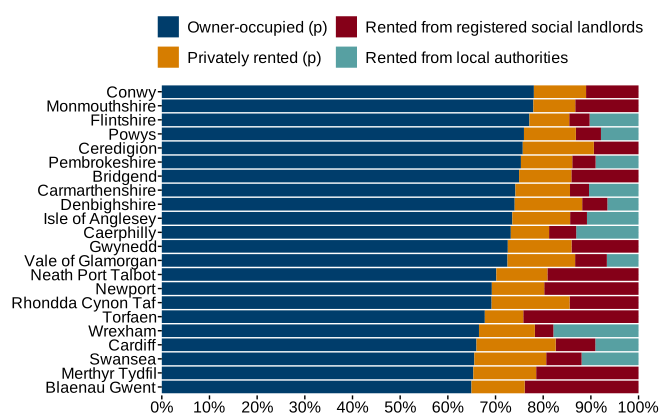
Description of figure 4: a stacked bar chart showing the tenure percentage breakdown for each local authority in Wales. The chart highlights that a large majority of dwellings in each local authority are owner-occupied.
Source: Welsh Government
Dwelling stock estimates percentages by year and tenure (StatsWales)
[Note 1] Owner-occupied includes intermediate tenure.
(p) Estimates of owner-occupied and privately rented stock are provisional and subject to revision following publication of 2025 APS (please see the quality report).
At 31 March 2025, the local authority with the highest proportion of private sector stock (owner occupied and privately rented) was Ceredigion at 91%. Monmouthshire and Conwy had the highest proportion of owner-occupied stock at 78%, whilst Cardiff had the highest proportion of privately rented stock at 17%.
Contrastingly, the local authorities with the highest proportion of social sector stock were Torfaen and Blaenau Gwent at 24%. All of the social sector stock in Torfaen and Blaenau Gwent was accounted for by registered social landlords. The highest proportion of local authority stock was in Wrexham, at 18%.
Vacant dwellings
There were an estimated 1,487,200 million dwellings in Wales at 31 March 2025, however, not all of these were occupied. The dwelling stock estimates shown in this release include vacant as well as occupied dwellings.
At the Census 2021, there were a total of 120,450 unoccupied dwellings in Wales (Office for National Statistics (ONS)) (8.2% of total dwellings) [Note 1]. The tenure breakdown provided by the Census should not be compared to the dwelling stock estimates, as Census tenure estimates do not include vacant dwellings, whereas social sector dwelling stock estimates include vacant dwellings.
Further information on Census data can be found in the quality and methodology section below.
[Note 1] The release previously stated the percentage of unoccupied dwellings in Wales as 6.1% which is the percentage for England. This has been changed to the correct figure for Wales: 8.2%.
Annual Population Survey (APS) dataset
The APS has seen a fall in sample sizes over recent years and the statistical uncertainty for estimates has increased. The APS has not yet been reweighted to include the latest population estimates from the 2021 Census. Therefore, the Office for Statistics Regulation (OSR) has agreed it’s official statistics accreditation should be temporarily suspended and the 2025 edition of the dataset is official statistics in development (OSR); the method is subject to change as quality issues in survey sources are addressed and depending on user feedback. Due to the above, the ONS no longer use the APS in their Subnational estimates of dwellings and households (ONS) for England (please see the quality report for more information.)
We believe that the APS is still the most appropriate data source for estimating the split of private sector dwellings into owner-occupied and privately rented tenure in Wales. Many of the national level estimates continue to provide a reasonable indication of trends for Wales. However, estimates for smaller geographies or population sub-groups are less reliable. Other surveys covering households in Wales have a smaller sample size than the APS, or are not available at local authority level, and would therefore be less reliable.
Future plans
Using administrative data to produce Dwelling stock estimates
We have previously shared our intention to explore how we may be able to use administrative data to produce dwelling stock estimates. Discussions are still ongoing into the feasibility of this work.
New house building statistics
The Welsh Government have recently explored how alternative sources of data could be used to enhance and quality assure New house building statistics. The latest feasibility report, published on 14 May 2026, explores the suitability of using Ordnance Survey (OS) data and Energy Performance Certificate (EPC) data. Over the next year, further work will be undertaken to assess the feasibility of using OS and EPC data to measure new house building activity, and explore the suitability of other data sources, such as Land Registry Price Paid data.
Glossary
Dwelling
For the 2021 Census, a dwelling is a unit of accommodation that may be empty or being lived in, for example houses or flats. They are usually made up of one household, but those with more than one household are shared and called a “shared dwelling”.
If a dwelling has no usual residents living in them, for example they are empty after being sold, these are called “unoccupied dwellings” but may be used by short-term residents or visitors on Census Day, 21 March 2021, for example holiday homes.
Household
A household is defined as one person living alone, or a group of people (not necessarily related) living at the same address who share cooking facilities and share a living room or sitting room or dining area. A household must contain at least one person whose place of usual residence is at the address. A group of short-term residents living together is not classified as a household, and neither is a group of people at an address where only visitors are staying.
Intermediate tenure
This includes properties developed for sale (including shared ownership and Homebuy) where ownership of the freehold (or head-leasehold) remains with the landlord.
This excludes fully stair-cased shared ownership dwellings and properties where the social landlord has sold the leasehold through right to buy but retains the freehold.
Non-self-contained dwelling
A non-self-contained unit is accommodation occupied by a household that lacks exclusive use of bath/shower or WC or some cooking facilities. These usually take the form of bedsit, shared housing, hostel or hostel type accommodation. Each bed space is therefore normally considered a non-self-contained unit.
Bedsits
A bedsit is accommodation with combined living and sleeping areas, for example a studio apartment. Depending on access to a bath or shower, inside WC and kitchen facilities, it is then classed as either:
- self-contained bedsits have exclusive use of a bath or shower, inside WC and some kitchen facilities; typically there may be several self-contained bedsits in a single larger property
- non self-contained bedsits are those contained in a single larger property and which lack exclusive use of bath or shower or WC or some kitchen facilities
Self-contained dwelling
A self-contained dwelling is accommodation occupied by a household with exclusive use of bath or shower, inside WC and some cooking facilities.
Tenure
The main tenure categories used in this release are:
- owner-occupied: this includes a dwelling that is owned outright or bought with a mortgage; or is part-rent and part-mortgage; or is part-mortgage and part equity loan
- rented privately: this includes those renting or living rent free where their landlord is a private rented landlord, employer or relative
- rented from registered social landlords
- rented from local authorities
Quality and methodology information
Detailed information on data quality and methodology can be found in the quality report.
Registered social landlord stock (2019 to 2020)
Due to the COVID-19 pandemic, registered social landlord data for 2019 to 2020 has been estimated. Registered social landlord stock data is relatively stable from year to year. Therefore, an average two-year annual increase (2016 to 2017 to 2018 to 2019) was calculated for registered social landlord stock. This average increase was then applied at a local authority and Wales level to 2018 to 2019 data to estimate 2019 to 2020.
Census data
The source of the baseline dwelling counts for these estimates are the 2001 Census, the 2011 Census and the 2021 Census. In Dwelling stock estimates: as at 31 March 2022 (published September 2023), we revised figures for 2012 to 2020 to calibrate to the Census 2021 dwelling count.
As outlined in the September 2023 release, the ONS advised that in Census 2021 improvements to the address frame were made. They also advised that using 2021 dwelling stock counts from census is preferred, rather than rolling forward since 2011 counts.
Following ONS’ publication, Number of vacant and second homes, England and Wales (published October 2023) we have worked with analysts from ONS and the Ministry of Housing, Communities and Local Government (MHCLG) to understand more about vacant dwellings within Census 2021.
The article Comparing empty home statistics in England and Wales (ONS), published 9 August 2024 (corrected 10 September 2024) considered the comparability of empty home statistics in England and Wales.
Official statistics status
All official statistics should show the standards of the Code of Practice for Statistics (Office for Statistics Regulation (OSR)).
These are accredited official statistics. They were independently reviewed by the OSR in July 2012. They comply with the standards of trustworthiness, quality and value in the Code of Practice for Statistics.
It is Welsh Government’s responsibility to maintain compliance with the standards expected of accreditation. If we become concerned about whether these statistics are still meeting the appropriate standards, we will discuss any concerns with OSR promptly. Accreditation can be cancelled or suspended at any point when the highest standards are not maintained, and reinstated when standards are restored.
Accredited official statistics are called National Statistics in the Statistics and Registration Service Act 2007.
Statement of compliance with the Code of Practice for Statistics
Our statistical practice is regulated by the OSR. OSR sets the standards of trustworthiness, quality and value in the Code of Practice for Statistics that all producers of official statistics should adhere to.
All of our statistics are produced and published in accordance with a number of statements and protocols to enhance trustworthiness, quality and value. These are set out in the Welsh Government’s Statement of Compliance.
These accredited official statistics (OSR)demonstrate the standards expected around trustworthiness, quality and public value in the following ways.
Trustworthiness
Data on new house building, demolitions and social housing stock are collected directly from local authorities and registered social landlords through their unique systems. Figures are checked and queried where necessary by Welsh Government statisticians.
Quality
The published figures provided are compiled by professional analysts using the latest available data and applying methods using their professional judgement and analytical skillset. Statistics published by Welsh Government adhere to the Statistical Quality Management Strategy which supplements the Quality pillar of the Code of Practice for Statistics (OSR) and the European Statistical System principles of quality for statistical outputs.
Data for the Welsh Government dwelling stock estimate publication is collected by Welsh Government directly from local authorities and registered social landlords, as well as extracted from the APS. Both local authorities and registered social landlords’ complete data collection forms based on data stored on their respective IT systems and return the completed forms to Welsh Government via its secure web data transfer system.
Validation checks are performed by Welsh Government statisticians and queries referred to local authorities and registered social landlords where necessary. The statistical release is then drafted, signed off by senior statisticians and published in line with the statement on confidentiality and data access which is informed by the trustworthiness pillar contained in the Code of Practice for Statistics (OSR).
Value
The dwelling stock estimates are used as evidence in policy making by both central and local government. The information provides an estimate of the number of residential dwellings by each tenure type and by local authority, at the end of March each year. The data are used by the Welsh Government, local authorities and other housing organisations to help monitor trends in the overall level of Welsh housing stock, as well as any changes in its tenure distribution over time.
You are welcome to contact us directly with any comments about how we meet these standards. Alternatively, you can contact OSR by emailing regulation@statistics.gov.uk or via the OSR website.
Well-being of Future Generations Act (WFG)
The Well-being of Future Generations Act 2015 is about improving the social, economic, environmental and cultural wellbeing of Wales. The Act puts in place seven wellbeing goals for Wales. These are for a more equal, prosperous, resilient, healthier and globally responsible Wales, with cohesive communities and a vibrant culture and thriving Welsh language. Under section (10)(1) of the Act, the Welsh Ministers must (a) publish indicators (“national indicators”) that must be applied for the purpose of measuring progress towards the achievement of the wellbeing goals, and (b) lay a copy of the national indicators before Senedd Cymru. Under section 10(8) of the Well-being of Future Generations Act, where the Welsh Ministers revise the national indicators, they must as soon as reasonably practicable (a) publish the indicators as revised and (b) lay a copy of them before the Senedd. These national indicators were laid before the Senedd in 2021. The indicators laid on 14 December 2021 replace the set laid on 16 March 2016.
Information on the indicators, along with narratives for each of the wellbeing goals and associated technical information is available in the Wellbeing of Wales report.
Further information on the Well-being of Future Generations (Wales) Act 2015.
The statistics included in this release could also provide supporting narrative to the national indicators and be used by public services boards in relation to their local wellbeing assessments and local wellbeing plans.