
Amcangyfrifon o’r angen am dai: sail-2025
Rhydd yr adroddiad hon amcangyfrifon sy'n seiliedig ar 2025 o'r angen cyffredinol am dai ychwanegol yng Nghymru. Saesneg yn unig.
Ar y dudalen hon
Revision note
This release was revised 05 August 2026. This revision was necessary because the low and high household projection variants used within these estimates, originally published on 20 November 2025, were revised on 4 June 2026 following the identification of a minor error.
As the calculation of newly arising need is based on the annual change in the high and low household projection variants, the revised projections have resulted in a corresponding update to these estimates. The central estimates of newly arising need, based on the principal population projection, and existing unmet need, are unchanged. Revisions in the lower and higher variant estimates of newly arising need are initially small, but increase over time (see Newly arising need (2022-based household projections)).
In Figures 1, 2 and 3, the low and high population variants have been revised and a 10-year migration variant has been added. Changes have been marked with an (r). The main messages have not changed as a result of these revisions.
Additional guidance for users in light of recently published population data
The 2024-based National population projections - Office for National Statistics, were published in April 2026, which show a different pattern for Wales compared with the earlier principal projection.
For Wales, the 2024-based principal projection is lower than any previous recent principal national population projection. It is also the only recent projection to show a decline in the population over the 25-year period from mid-2024 to mid-2049. This is different to the trend shown by the 2022-based population projections, which underpin the 2022-based household projections used in these estimates of additional housing need. Although updated household projections have not yet been calculated, it is probable that they would follow a similar direction to the latest population projections, which show a decline in the population of Wales over the projection period
The latest population estimates, published 29 July, show a decrease in the population between 2024 and 2025. A Chief statistician’s blog published alongside those estimates provides further context and notes that it is not yet clear whether this small population decline will continue in the coming years.
New estimates of additional housing need will be produced once updated household projections are available.
In the meantime, users of this output are advised that evidence from the latest national population projections and population data suggests that the estimates of additional housing need published here are likely to be at the upper end of the range.
Within this revised publication, we have also included estimates of additional housing need using the 10-year migration household projection variant, alongside other projection variants.
Including the 10-year migration variant provides users with an additional point of comparison when considering the potential range of future additional housing need.
Introduction
The 2025‑based housing need estimates show how many extra housing units may be needed in Wales over the next 20 years. These replace the 2019-based estimates.
The figures are based on two parts:
- existing unmet need, estimated from households that are both overcrowded and concealed (Office for National Statistics (ONS)) , and homeless households in temporary accommodation
- newly arising need, estimated from 2022-based household projections
For the first five years, we also show an approximate tenure split between market housing and affordable housing. Because any long‑term estimates are uncertain, we provide a range of estimates using different household projection assumptions.
Full definitions can be found in the quality report.
A Chief Statistician’s blog published 12 February, alongside the estimates, explains more about the estimates and what they tell us.
Quality and limitations
These estimates:
- show a range of possible need for additional housing units, based on past trends and the best available data agreed with an expert technical group
- provide an indication of how additional housing need could be split between market and affordable housing, based on a set of assumptions
- support discussions about future housing policy
These estimates:
- cannot predict what will happen in the future
- should not be used as housing targets
- do not estimate the number of households living in unsuitable accommodation (for example, those in disrepair or requiring adaptations)
- are not yet based on more recent population projections
To make sure the estimates are robust and transparent, a technical group was set up at the start of the work and has supported previous versions. The group includes analytical and policy experts from Welsh Government and local government, and advises on methods and technical issues.
Although the methodology is broadly the same as for the 2019-based estimates, some changes have been made to the data sources and assumptions. For example, existing unmet need is presented as a single estimate rather than being spread over an assumed number of years. The sources used to estimate future changes in income and private rent prices have also been updated to reflect the best available data.
After discussing with users, estimates are produced at the national level only; regional estimates are no longer produced. More detail on these changes is provided in the quality report.
Definition of time periods
Annual estimates in this release run from July to the following June. For example, the period July 2025 to June 2026 represents one annual estimate, and is presented as year ending June 2026. This aligns with the mid-year estimates used in household projections.
Five‑year blocks are described using the first July and the final June in the period. For example, the block covering July 2025 to June 2026 through to July 2029 to June 2030 is described as July 2025 to June 2030.
Main points
There is currently an estimated existing unmet need of 9,400 housing units.
Estimates of existing unmet need have increased by 64% since the 2019‑based estimates, due to a rise in homeless households in temporary accommodation.
On average, between 7,300(r) and 9,800(r) additional housing units are estimated to be needed annually over the five year period from July 2025 to June 2030, with a central estimate of 8,700 from newly arising need.
The estimated newly arising need for July 2025 to June 2030 is higher than in the 2019‑based estimates.
This increase reflects higher projected household growth in the 2022‑based household projections compared with the 2018‑based projections used previously; household projections are mainly driven by population projections.
Growth in newly arising need, using the principal projection, is projected to slow down over the next 20 years, in line with a gradual reduction in projected household growth in the 2022‑based projections.
Over the next five years, around 65% of newly arising need is estimated to be for market housing, and around 35% for affordable housing. We assume that all existing unmet need is for affordable housing.
Overall estimates of additional housing need
The 2025‑based estimates use the same definitions and broad methodology as the 2019‑based estimates. The main change is that existing unmet need and newly arising need are now shown separately, rather than combined. More detail on this change is provided in the quality report.
These estimates bring together:
- existing unmet need (shown as a single figure)
- newly arising need (shown over future years)
To reflect the uncertainty in long‑term projections, we show results based on the principal household projection as well as the upper, lower and 10-year migration variant projections.
These variants use different assumptions about future fertility, mortality and migration. They give an indication of the possible range of outcomes but are not upper or lower limits.
Figure 1: average annual estimates of additional housing need, for 5-year periods, July 2025 to June 2045 (r)
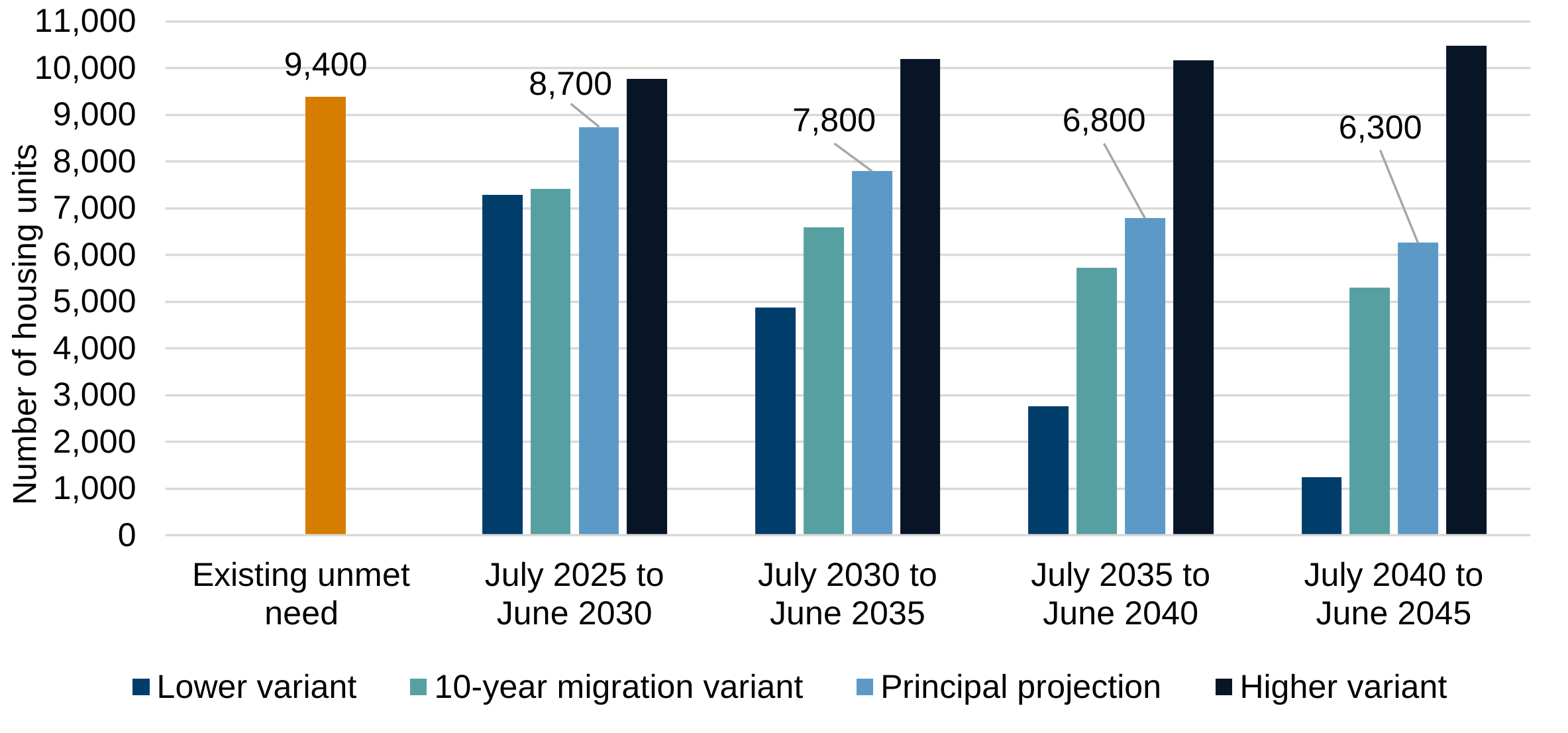
Description of figure 1: this column chart shows the average annual estimates of additional housing need, for 5-year periods. The estimates are based on variant household projections. The average annual newly arising need gradually reduce from a central estimate of 8,700 over the period July 2025 to June 2030 to 6,300 for the period July 2040 to June 2045. The first column in this chart shows existing unmet need as a standalone figure.
Source: 2025-based estimates of additional housing need (Welsh Government)
Existing unmet need
Existing unmet need is the number of households that require an additional housing unit because:
- they are currently homeless and living in temporary accommodation, or
- their current home is overcrowded and they are hidden within another household (concealed)
Households who may need a different type of home, but not an extra unit, are not included in this analysis.
It is difficult to measure existing unmet need. For this analysis, existing unmet need is estimated from two sources:
- Homeless households in temporary accommodation (March 2025 snapshot)
- Households that were both overcrowded and concealed (ONS) (Census 2021)
The number of homeless households in temporary accommodation comes from the Welsh Government’s statutory homelessness release for April 2024 to March 2025. At the end of March 2025, there were 6,300 such households.
The number of overcrowded and concealed households is taken from an ONS commissioned table based on Census 2021. The technical group considered this to be the best available estimate. On Census day 2021, there were 3,100 overcrowded and concealed households in Wales.
| Concealed and overcrowded households | Homeless households in temporary accommodation | Total |
|---|---|---|
| 3,100 | 6,300 | 9,400 |
Description of table 1: this table shows the two components of existing unmet need, giving a combined estimate of 9,400 households
Source: Census 2021 (ONS), Homelessness data collection (Welsh Government)
Changes from previous estimates
In previous estimates we assumed that existing unmet need would be cleared within 5 years. We therefore divided the estimate of existing unmet need by 5 and combined with the newly arising need estimates.
Due to recent trends in the number of homeless households in temporary accommodation the technical group agree that this assumption is no longer reasonable so we present existing unmet need as a standalone snapshot, rather than spreading it over a number of years.
Newly arising need (2022-based household projections)
Newly arising need is the projected number of newly forming households that will require additional housing units for a period in the future. It is calculated as the difference in household projections from one year to the next. For this work, it is taken from the latest available household projections. The 2022-based projections were published in November 2025, and revised in June 2026.
Household projections are not forecasts. They are based purely on past trends and assume these trends continue. Such projections do not attempt to account for the effect of future polices, changing economic circumstances or other factors, such as the number of homes built.
To illustrate the uncertainty associated with the projections, higher, lower and 10-year migration variants (full definitions can be found in the quality report) of household projections are produced to provide a range of future estimates of additional housing need.
Figure 2: newly arising need: 2022-based household projections (r)
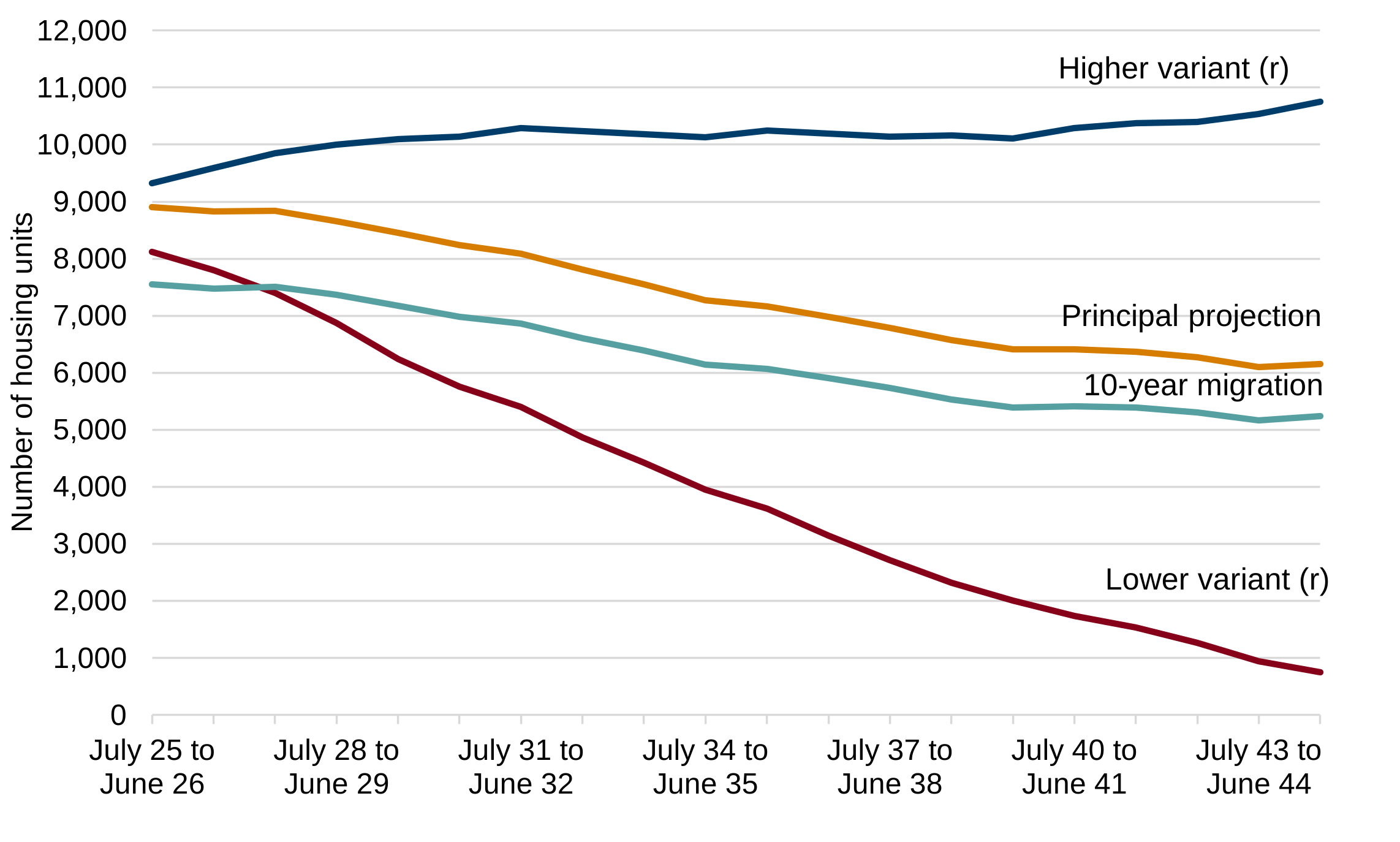
Description of figure 2: the line chart shows newly arising need for additional housing units across the 20 year period to the year from July 2044 to June 2045. During this period, under the principal projection, newly arising need gradually reduces from 8,900 in July 2025 to June 2026 to 6,100 in July 2044 to June 2045. The gradual reduction in the rate of increase in newly arising need reflects the slowdown in growth in the 2022-based household projections.
By 2032 to 2033, the revised newly arising need for the low population variant is around 1,700 (25.5%) lower than the original estimate using the low population variant. By 2044 to 2045, this difference increases to around 3,800 (83.5%). The revised newly arising need for the lower variant is 700 housing units in 2044 to 2045.
By 2032 to 2033, the revised newly arising need for the high population variant is around 1,400 (16.5%) higher than the original estimate using the high population variant. By 2044 to 2045 this difference increases to around 3,300 (45.0%).
Source: 2022-based household projections by local authority, household type, year and variant on StatsWales
Estimates of additional housing need split by tenure
Additional housing need is split by tenure for the first five years of the estimates. Splitting the estimates beyond this period is not considered reliable because of increasing uncertainty over the longer term.
The tenure split is based on a series of assumptions. Different assumptions would lead to different estimates, and the sensitivities around these are described in the quality report.
Using the data sources and assumptions set out in this release, the estimates suggest that, in each of the next five years, around 65% of newly arising housing need is for market housing, and around 35% is for affordable housing. All existing unmet need is assumed to require affordable housing.
Figure 3: average annual estimates of additional housing need, split by tenure, July 2025 to June 2030 (r)
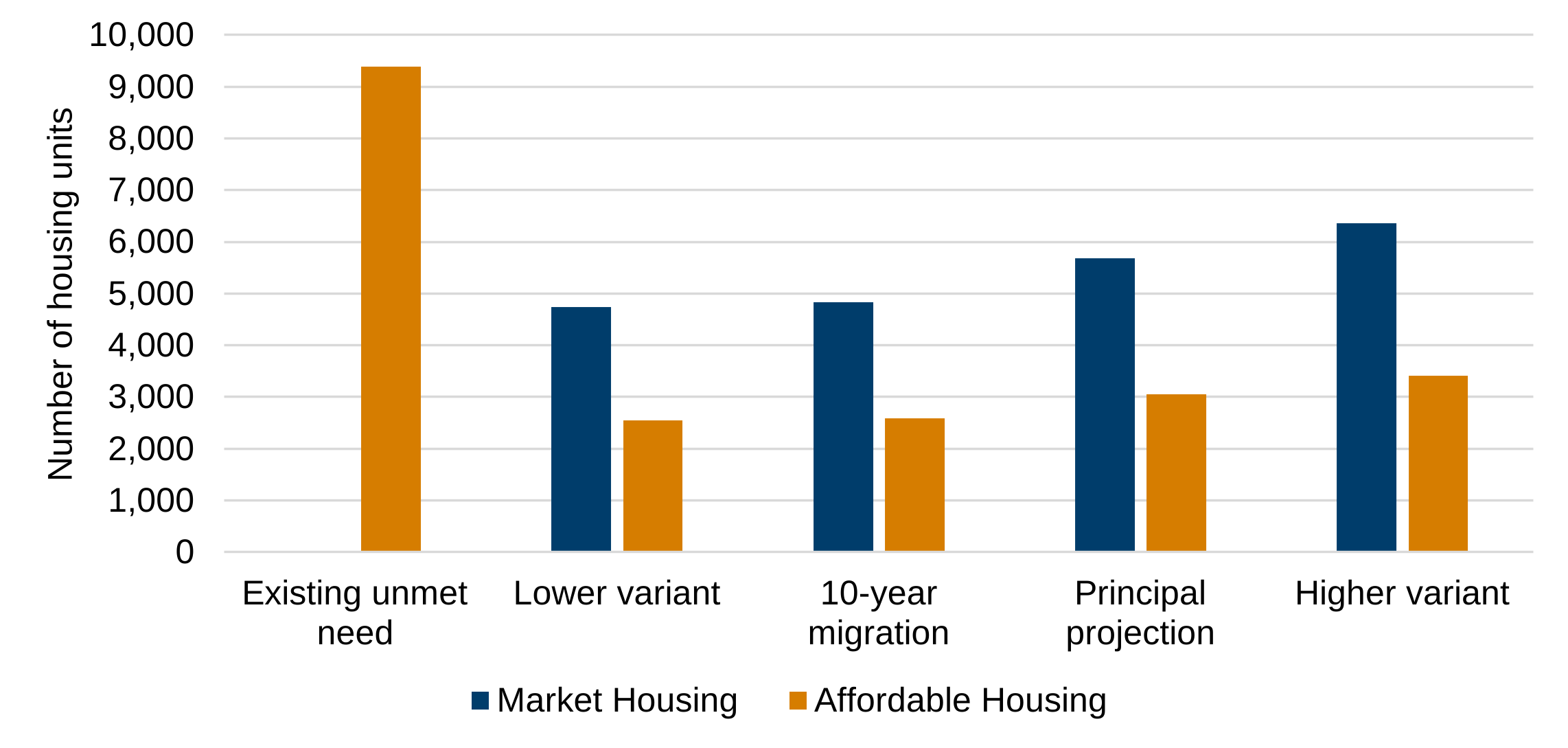
Description of figure 3: the column chart shows the average annual estimates of additional housing need split by tenure between year ending June 2026 and year ending June 2030 under the central estimate, higher, lower and 10-year migration variants. Existing unmet need is shown as a standalone snapshot and is not averaged over the 5-year period.
Source: 2025-based estimates of additional housing need (Welsh Government)
The average annual estimates of newly arising need by tenure over July 2025 to June 2030 vary under the different variants of household projections:
- Market housing ranges from 4,700(r) units per year (lower variant) to 6,400(r) units (higher variant), with a central estimate of 5,700 units.
- Affordable housing ranges from 2,500(r) units per year (lower variant) to 3,400(r) units (higher variant), with a central estimate of 3,000 units.
All households included in existing unmet need are treated as requiring affordable housing. The estimated level of existing unmet need in 2025 is 9,400 housing units.
Growth in private rental prices
One of the key inputs used to calculate the tenure split is the assumed increase in private rental prices over the next five years.
In the 2019‑based estimates, private rent was assumed to rise in line with average earnings, using the Office for Budget Responsibility (OBR) average earnings forecast.
The OBR now provides a forecast for private rents for housing as part of its inflation forecast, we have used this forecast to estimate growth in private rental prices for the 2025‑based estimates. Economic and fiscal outlook: November 2025 (OBR).
More information on the assumptions used, and on how sensitive the results are to changes in these assumptions, is provided in the quality report.
Manylion cyswllt
Ystadegau Tai
E-bost: ystadegau.tai@llyw.cymru
Cyfryngau: 0300 025 8099
SDR 11/2026